KZC said there has been no meaningful resolution to the crisis, cautioning that participation in government-led dialogues could undermine the community’s political stance.
BY PC Bureau
April 11, 2026: The Kuki-Zo Council (KZC) has issued a formal advisory urging Kuki-Zo civil society organisations (CSOs) to abstain from participating in proposed inter-tribe meetings being organised by district administrations in Manipur.
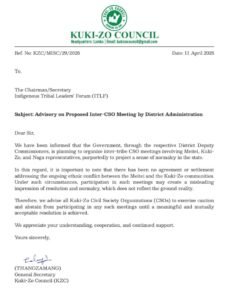
In a letter dated April 11 and addressed to the leadership of the Indigenous Tribal Leaders’ Forum (ITLF), the council cautioned that such meetings could create a misleading impression of normalcy while the underlying ethnic conflict remains unresolved.
The advisory (Reference: KZC/MISC/29/2026), signed by General Secretary Thangzamang Zou, stated that district authorities are planning engagements involving Meitei, Kuki-Zo, and Naga representatives. However, it stressed that “there has been no agreement or settlement addressing the ongoing ethnic conflict,” warning that participation could project a false sense of resolution on the ground.
The KZC urged all Kuki-Zo CSOs to “exercise caution and abstain” from such meetings until a meaningful and mutually acceptable political solution is reached.
Ongoing Conflict and Deep Divisions
Manipur has been grappling with ethnic violence since May 2023, primarily between the valley-based Meitei community and the hill-based Kuki-Zo groups. The conflict has resulted in over 260 deaths, widespread displacement, and a deep geographical divide, with buffer zones and segregated areas becoming the norm.
Tensions have continued into 2026, with periodic incidents reigniting fears. A recent attack in Bishnupur district that killed two children further escalated the situation, triggering protests and fresh unrest.
KZC’s Political Stand
The Kuki-Zo Council, led by Chairman Henlianthang Thanglet, has consistently advocated for a separate administration for Kuki-Zo areas, preferably in the form of a Union Territory.
The council has also maintained a cautious approach to engagement with the state government. While it participated in limited dialogue, including a meeting with Chief Minister N. Biren Singh earlier this year, it has reiterated that any participation in political or administrative processes must be tied to substantive progress on core demands.
Optics vs Ground Reality
Analysts say the advisory reflects deep skepticism within the Kuki-Zo community toward initiatives perceived as prioritising optics over substance. From their perspective, inter-tribe meetings risk legitimising a narrative of normalcy without addressing key issues such as justice for victims, rehabilitation of displaced families, and long-term political arrangements.
READ: Manipur: A Leader Who Rarely Speaks for Her Own People
READ: CoTU Members Quit Over Leaders’ Silence on Buffer Zone Breach by Manipur CM
At the same time, the state government is believed to view such meetings as confidence-building measures aimed at restoring dialogue and reducing mistrust among communities.
However, without the participation of key stakeholders like the KZC and ITLF, the effectiveness and legitimacy of these initiatives remain uncertain.
A Fragile Path Forward
The advisory comes at a sensitive juncture, highlighting the gap between official efforts to stabilise the situation and the lived realities of conflict-affected communities.
Observers note that any sustainable peace process will require moving beyond symbolic engagements to address the root causes of the conflict, including governance structures, security concerns, and accountability.
For now, the KZC’s call for a boycott signals that positions remain hardened, and that meaningful dialogue may still be some distance away.