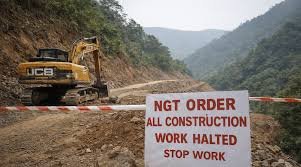
KANAM said the December 23 order was issued despite authorities being aware that Kuki-Zo hill areas lack safe access to national highways and depend on hill roads for medical evacuation and essential supplies.
BY PC Bureau
New Delhi, December 30, 2025: The Kuki Alliance for Nampi Awakening Movement (KANAM) has written to United Nations High Commissioner for Human Rights Volker Türk, raising alarm over a recent National Green Tribunal (NGT) order halting construction related to a Ring Road project in Manipur’s Kuki-Zo hill districts, warning that the decision could have “foreseeable humanitarian consequences” for civilians living in conflict-affected areas.
In a letter dated December 30, KANAM said it represents the Kuki-Zo indigenous population in Manipur, which it described as “presently facing systematic persecution, isolation, and institutional abandonment” amid the ongoing ethnic violence in the state.
The organisation objected to a December 23, 2025 order passed by the NGT’s Eastern Zone Bench in Kolkata, which imposed a blanket prohibition on further construction connected to the Ring Road Project, known as German-Tiger Road, and directed district administrations and police authorities to strictly enforce the halt.
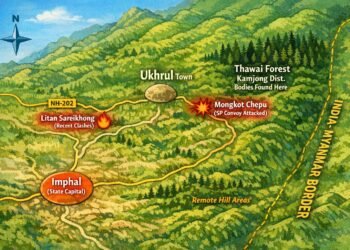
KANAM said the order was issued despite authorities being “fully aware, or at the very least constructively aware,” that Kuki-Zo areas no longer have safe or reliable access to National Highways. According to the letter, these areas are almost entirely dependent on hill connectivity for “medical evacuation, food supplies, civilian movement, and survival.”

Calling the decision deeply troubling, KANAM stated, “This decision cannot be characterised as a neutral environmental act. It is a decision taken in wilful disregard of foreseeable humanitarian consequences.” The group argued that procedural compliance with environmental regulations does not absolve authorities of responsibility when lives are at risk.
“When an authority knowingly obstructs evacuation routes and essential access for a population already living under siege conditions, it becomes morally and institutionally responsible for the harm that follows,” the letter said.
The organisation further criticised the tribunal for, in its view, penalising civilians rather than holding defaulting state authorities accountable. “It is particularly alarming that the Tribunal chose to penalise the affected population rather than compel compliance from defaulting state authorities who repeatedly failed to submit reports or conduct mandated studies,” KANAM wrote.
KANAM noted that the order did not carve out any humanitarian exemptions. “No humanitarian exemption was carved out. No emergency or civilian corridor was recognised. No balancing exercise between environmental safeguards and the right to life is visible on the face of the order,” the letter said.
Warning of potentially fatal consequences, the organisation stated that deaths caused by blocked ambulance access, shortages of food and medicines, or civilians being forced onto unsafe routes “will not be accidental.” Such outcomes, it said, would be “the direct and foreseeable consequence of institutional choices.”
READ: Priyanka Gandhi Vadra’s Son Raihan Engaged to Longtime Partner Aviva Baig
“In such circumstances, responsibility lies squarely with the National Green Tribunal, the Government of Manipur, and the Government of India,” the letter added.
KANAM urged the Office of the UN High Commissioner for Human Rights to urgently document the issue and engage with Indian authorities. “Environmental governance must not be permitted to function as a tool of collective punishment against an indigenous minority,” it said.
The organisation said it has enclosed copies of the NGT order dated December 23, 2025, details of the Ring Road Project and its humanitarian necessity, maps showing loss of safe access to National Highways, and background documentation on conflict conditions and civilian risk.