Two men from Churachandpur and Kangpokpi districts were handed over to the Assam Rifles by the JTCM after repeated attempts to secure representation from their respective communities proved unsuccessful, highlighting growing strains in Manipur’s fragile inter-tribal relations.
BY PC Bureau
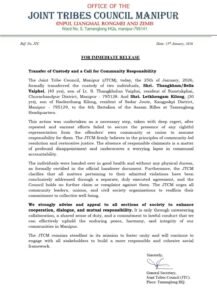
January 25, 2026: In a development underscoring the complex intersection of tribal governance, community accountability, and security operations in Manipur’s ethnically volatile landscape, the Naga-dominated Joint Tribes Council, Manipur (JTCM) on Saturday transferred custody of two Kuki men s from the Kuki-Zo community to the 6th Battalion of the Assam Rifles at Tamenglong Headquarters.
The JTCM, a coalition representing various indigenous tribal bodies—primarily from Naga-dominated hill districts—said the handover was necessitated after repeated efforts to secure representatives from the individuals’ respective communities or organisations failed, raising concerns over communal disengagement and eroding trust mechanisms in the region.
The two men were identified as Thangkham alias Bella Vaiphei (40), son of the late S. Thangkholun Vaiphei of Sumtukphai village in Churachandpur district, and Letkhongam Kilong (30), son of Haolenthang Kilong of Sadar Joute in Kangpokpi district
Background and Context of the Handover
In a detailed statement, the JTCM— which functions as a mediating body for tribal disputes in Naga-majority areas such as Tamenglong—expressed “deep regret” over the decision to hand over the two men to a central security force. According to the council, the individuals had been in its custody following what it described as “admitted violations,” though the nature of the violations was not publicly disclosed.
The JTCM said the matter had been resolved through a “separate agreement” rooted in restorative justice, a customary mechanism widely practised by tribal councils to promote reconciliation without recourse to formal legal proceedings. However, despite the resolution, efforts to facilitate a community-led handover failed due to the absence of “responsible claimants” from the men’s respective community bodies or unions.
The council described this absence as a “concerning lapse in communal responsibility,” reflecting broader strains both within and between tribal groups in Manipur’s fractured socio-political environment. Incidents of this nature, the statement noted, often arise from inter-tribal suspicion, territorial sensitivities, or activities linked to the ongoing violence.
Tamenglong, a Naga-majority district where the influence of various National Socialist Council of Nagaland (NSCN) factions has historically shaped local dynamics, has long maintained a fragile equilibrium with neighbouring Kuki-Zo communities. The presence of Kuki-Zo individuals in Naga-dominated areas has at times resulted in detentions on suspicions ranging from encroachment and smuggling—including narcotics or arms—to alleged militant involvement, tensions that have intensified since the outbreak of violence in 2023.
READ: Horrific Murder Inside Mumbai’s Train Caught on CCTV
While specific details of the “admitted violations” remain undisclosed, searches across news outlets and social media platforms as of January 25, 2026, yielded no additional public reporting on the matter, likely owing to the sensitivity surrounding tribal affairs and the recency of the incident. Contextually, the violations may relate to breaches of local customary laws or security concerns in a sensitive hill district prone to cross-border challenges involving Myanmar, including illegal migration, poppy cultivation, and arms trafficking.
Handover to Assam Rifles
The JTCM emphasised that the handover was conducted in a humane manner, stating that both individuals were in good health at the time of transfer and that this was formally documented. The council further clarified that it holds no remaining claims or grievances against the two men, framing the transfer as a last-resort measure to ensure lawful oversight rather than an escalation of punitive action.
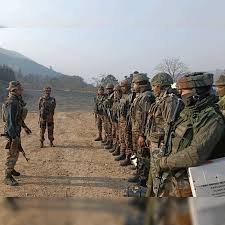
The decision to involve the Assam Rifles—a central paramilitary force under the Ministry of Home Affairs with a key role in counter-insurgency and border security operations in Manipur—was attributed to the force’s perceived neutrality in the state’s ethnic conflicts. Unlike the state police, which have faced repeated allegations of bias from different communities, the Assam Rifles, with personnel drawn from across the Northeast including Naga and Kuki backgrounds, is often viewed as a comparatively impartial intermediary.
The 6th Battalion stationed at Tamenglong Headquarters is strategically positioned to manage such custodial transfers, ensuring that individuals are processed through formal security and legal channels, including further investigation or release should no charges be established.
Broader Implications
The JTCM said the handover aligns with its broader appeal for “collective responsibility, dialogue, and lawful conduct” among community leaders, civil society organisations, and tribal unions. It stressed that sustained cooperation remains critical for restoring peace in Manipur, where ethnic divisions have led to armed confrontations, prolonged blockades, and an ongoing humanitarian crisis.
The incident unfolds against continued unrest in the state, as Kuki-Zo groups persist in demands for separate administration or enhanced autonomy, citing targeted violence and systemic governance failures. Recent public commemorations, including a candlelight vigil in Guwahati for a Kuki-Zo rape survivor who later died from trauma related to the 2023 violence, have underscored unresolved grievances and the demand for accountability.
The JTCM has pledged continued engagement with all stakeholders to promote unity and stability. Yet, in the absence of public disclosure regarding the violations involved, questions surrounding accountability and procedural clarity remain. As Manipur continues to navigate a fragile and uneven peace, the episode highlights the persistent challenges of governance, trust, and inter-community relations in the state’s conflict-affected hill regions.