Analysts warn that the ongoing proxy war between Naga and Meitei-aligned actors risks pushing Manipur toward prolonged instability, with civilians bearing the brunt of politically orchestrated violence.
BY PC Bureau
January 26, 2026: Fresh violence in Manipur’s hill districts has intensified allegations that Naga armed groups are fighting a proxy war in the ongoing Kuki-Zo–Meitei conflict, with Kuki-Zo villages increasingly becoming targets of arson, intimidation, and collective punishment.
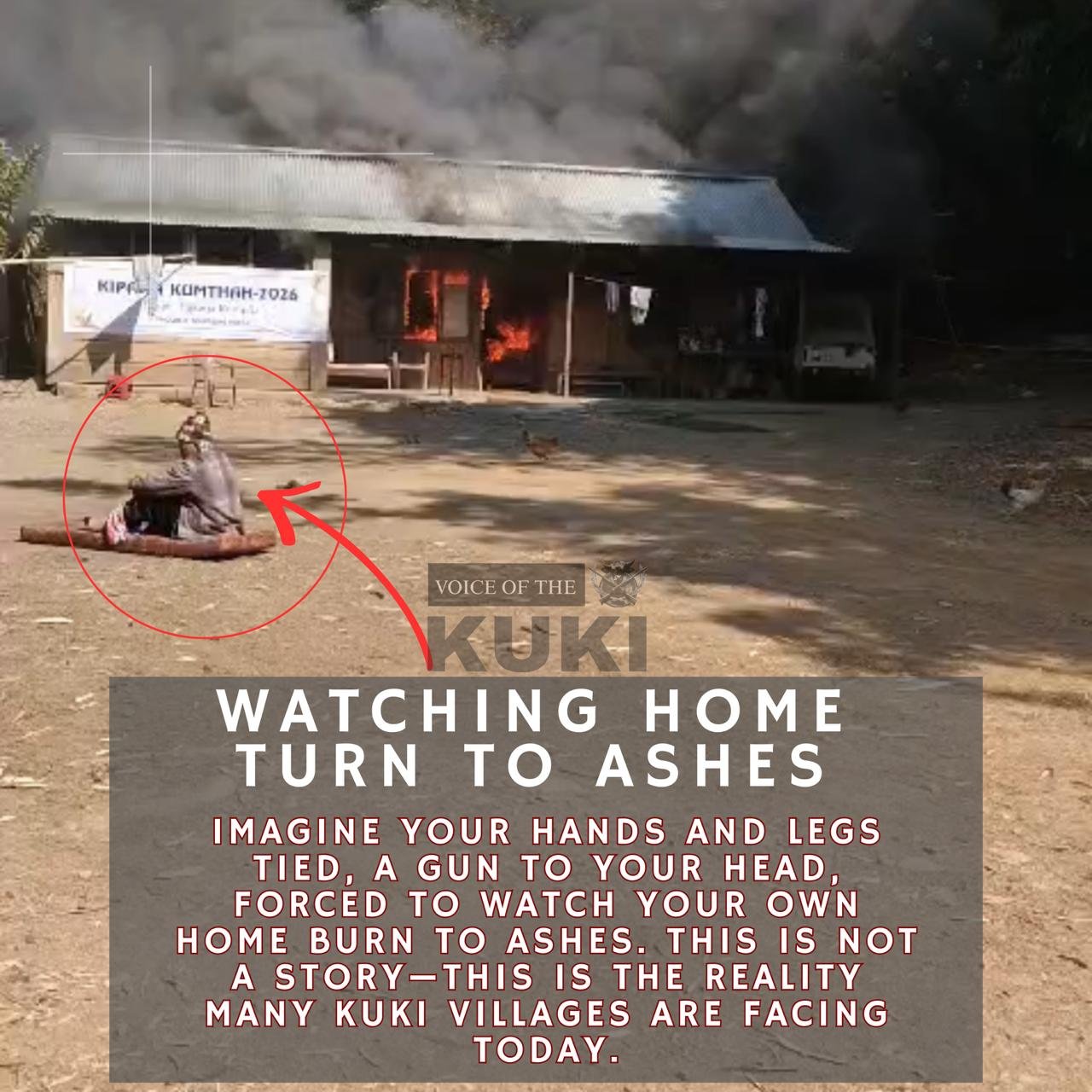
The latest flashpoint occurred on January 26, when the Zeliangrong United Front (ZUF)—an armed group claiming to represent Zeliangrong (including Kacha Naga) communities—allegedly razed K. Songlung (II), a Kuki-Zo village in Kangpokpi district. The incident prompted the Committee on Tribal Unity (COTU), Sadar Hills, to threaten a blockade of National Highways 2 and 37, citing repeated attacks on Kuki-Zo settlements.
According to reports from the area, ZUF cadres allegedly herded villagers together, tied their hands, and blindfolded several residents before setting houses on fire in broad daylight. The attack, which took place on Republic Day, has drawn particular outrage among Kuki-Zo groups, who described it as a symbolic assault on civilians as the country marked the 77th anniversary of the Constitution.
READ: Kuki Rights Group Condemns Shaurya Chakra Award to CRPF Officer Linked to 2024 Manipur Killings
READ: Disarmed. Pinned. Shot. New Video Puts US Federal Agents in the Dock for “Murder”
Villager’s Testimony Describes Terror and Intimidation
A viral video circulating on social media features the wife of the village chief of K. Songlung (II) describing what she said were moments of extreme terror during the incident. In her account, she alleged that armed men gathered villagers in one place while firing shots nearby.
“They herded us together. Some of us were blindfolded. It sounded like they were firing shots to the left and right of us,” she said. “I was so terrified, I kept praying, wondering when they would shoot us dead.”
She claimed that when she attempted to lift her blindfold to see what was happening to her home, one of the attackers shouted at her not to remove it. “When I finally felt they had gone and took off the blindfold, my entire house was already engulfed in flames,” she said.
I unequivocally condemn the unprovoked attack and burning of K Songlung Village in Kangpokpi District by heavily armed Zalengrong militants today. Despite President’s Rule and over 60,000 Central security forces on the ground, attacks on Kuki-Zo villages continue unchecked. This… pic.twitter.com/bLlaZmYSS5
— H S Benjamin Mate (@BenjaminMate1) January 26, 2026
According to her testimony, villagers were unable to approach the burning houses, as their hands were tightly bound. “I tried to untie the ropes binding their hands behind their backs, but the knots were too tight,” she said, adding that while no one was taken away, everyone was restrained and blindfolded.
She also described the treatment of an elderly man. “The grandfather here is almost completely blind because of old age. They only tied his hands and forced him to ‘watch.’ They dragged him across the house,” she said, identifying the man as being nearly 100 years old.
“At that moment, I was convinced my life was over,” she added. “At first, I was thankful to still be alive. But when I saw the house burnt to ashes, I felt helpless and heartbroken.” She also recalled children crying in fear as shots were fired nearby, asking whether they would be killed.
The claims made in the video could not be independently verified, but they have intensified anger among Kuki-Zo civil society groups, who say the testimony reflects a growing pattern of intimidation against civilians.
A Pattern of Pressure on Kuki-Zo Villages
The Songlung incident is not isolated. Over recent months, multiple reports have emerged of Naga armed groups abducting Kuki-Zo villagers, blocking access roads, firing at settlements, and enforcing movement restrictions in disputed hill areas.
Songlung itself was among the villages destroyed during the May 2023 ethnic violence, which displaced over 60,000 people and left more than 260 dead across Manipur. Residents had begun rebuilding the village before it was allegedly razed again.
Alleged Proxy Alignment
Adding to concerns are persistent allegations that valley-based armed outfits and certain Naga insurgent groups are working in tandem to target Kuki-Zo villages, effectively shifting the conflict into the hills. While contested, the proximity between Naga and Meitei civil society organisations (CSOs) is widely acknowledged in Manipur’s political discourse.
Kuki-Zo organisations argue that this convergence has resulted in a proxy dynamic, where Naga groups confront Kuki-Zo civilians under the banner of poppy eradication or land enforcement, while valley-based actors benefit strategically. Observers note that in some cases, the attacks appear to serve the broader political and territorial objectives of Meitei groups, with Naga outfits acting as intermediaries in contested areas.
Some analysts suggest that the Naga involvement provides a layer of plausible deniability for valley-based Meitei actors while keeping the conflict localized in the hills, allowing Meitei factions to exert pressure on Kuki-Zo communities without direct engagement. This, they argue, represents a growing pattern of proxy warfare, with civilians bearing the brunt of politically orchestrated violence.
Kuki-Zo organisations claim that the lack of visible action by the Manipur Governor and the state administration against the alleged excesses of ZUF cadres has further eroded trust. They argued that the absence of punitive measures has strengthened perceptions that the authorities are turning a blind eye, a posture they claim aligns with prevailing political and security considerations in the state.
According to these groups, what they describe as selective enforcement has emboldened armed groups in the hills while leaving Kuki-Zo civilians vulnerable to displacement and without effective institutional protection in several parts of the hills.
A Fragile and Volatile Landscape
Despite heavy deployment of security forces, Manipur’s ethnic fault lines remain volatile. Competing claims over land, political authority, and control of narcotics routes continue to drive cycles of unrest.
As villages like K. Songlung are once again reduced to ashes, Kuki-Zo groups warn that continued impunity risks pushing Manipur toward another prolonged phase of instability—one increasingly shaped, they argue, by proxy warfare rather than open confrontation.