BY PC Bureau
March 1, 2026 – In a dramatic escalation of tensions in the Persian Gulf, Iranian forces attacked the Palau-flagged oil tanker Skylight as it transited the strategic Strait of Hormuz near the coast of Oman, according to Omani authorities and multiple international reports.
The incident occurred approximately five nautical miles north of Khasab Port in Oman’s Musandam Governorate and marks the first reported direct attack on commercial shipping in the vital waterway since renewed hostilities erupted involving Iran, the United States, and Israel.
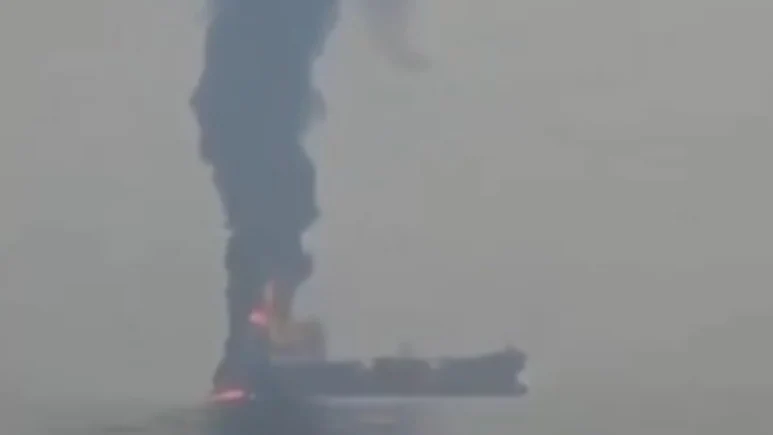
Oman’s Maritime Security Centre confirmed that the vessel came under attack earlier today, resulting in injuries to four crew members. The tanker’s full 20-person crew — comprising 15 Indian nationals and five Iranian nationals — was safely evacuated following the strike. Preliminary reports indicate the attack involved projectiles or drones, leaving the ship damaged and, according to some accounts, engulfed in flames and smoke.
While Omani officials have not explicitly identified the perpetrator in all public statements, multiple sources — including regional media, social media footage, and maritime security alerts — attribute the strike to Iranian forces. The attack follows days of Iranian threats to restrict or close the Strait of Hormuz in retaliation for joint U.S.-Israeli military strikes on Iranian targets, reportedly including sites linked to the country’s leadership and nuclear infrastructure.
The Strait of Hormuz, a narrow chokepoint bordered by Iran to the north and Oman to the south, remains one of the world’s most critical oil transit routes. Roughly one-fifth of global oil consumption — approximately 20–21 million barrels per day — flows through the passage, connecting major Gulf producers such as Saudi Arabia, Iraq, the United Arab Emirates, Kuwait, and Iran itself to international markets.
Iran has attacked the Palau-flagged oil tanker Skylight as it was passinf through the Strait of Hormuz right off the coast of Oman. 4 sailors wounded in the attack. The entire crew has been evacuated. pic.twitter.com/ns8FRbhLem
— Navroop Singh (@TheNavroopSingh) March 1, 2026
READ: Iran Expands Retaliation Beyond Israel, Targets US Bases Across Gulf
Shipping traffic through the strait has already fallen sharply in recent days, with tracking data indicating declines of up to 70% following the initial U.S.-Israeli operations against Iran. Iran’s Revolutionary Guard Corps (IRGC) has reportedly broadcast warnings via VHF radio stating that “no ship is allowed to pass” through the strait, though Tehran has not formally declared a full closure. Major oil companies and commodity traders have suspended shipments through the waterway as a precaution, heightening fears of severe disruptions to global energy supplies.
The targeted vessel, Skylight, had previously been identified by the United States as a “sanctioned enabler” of Iranian petroleum exports, adding complexity to the incident. Analysts suggest the strike may represent a calibrated response — targeting a vessel linked to sanctioned oil trade networks while signaling broader deterrence to international shipping amid the expanding conflict.
The attack coincides with separate drone strikes reported on commercial ports in the region, including Duqm in Oman and Jebel Ali in the UAE, underscoring the widening geographic scope of the confrontation. Oman, long regarded as a neutral mediator in Gulf disputes, now finds its territorial waters directly impacted.
International reaction has been swift, with maritime agencies issuing heightened advisories for vessels operating in the Persian Gulf and the Arabian Sea. The U.S. Navy has previously stated it cannot guarantee the safety of commercial shipping in the area, while European naval monitoring missions have relayed warnings about threats to passing ships.
Oil markets responded immediately, with Brent crude futures posting early gains amid concerns over prolonged supply disruptions. Energy analysts warn that a sustained threat to the Strait of Hormuz could drive prices well above $100 per barrel, drawing comparisons to the tanker wars of the 1980s during the Iran-Iraq conflict.
As the situation unfolds, global attention remains fixed on the narrow waters of the Strait of Hormuz, where any further escalation could send shockwaves through energy markets and economies reliant on uninterrupted oil flows. Oman has called for restraint and de-escalation, but with military exchanges continuing across the region, the risk of additional incidents involving commercial vessels remains high.