The Islamic Revolutionary Guard Corps said it launched missiles and drones at U.S. bases in Kuwait, Jordan, Bahrain, and Israeli targets in a coordinated regional operation.
By PC Bureau
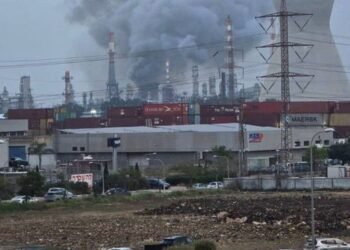
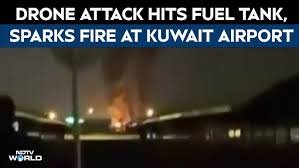
March 25, 2026 — A fire erupted early Wednesday morning at Kuwait International Airport after drones struck fuel storage tanks, the Gulf state’s Directorate General of Civil Aviation reported. The incident followed an announcement from the Kuwaiti army that its air defense systems were actively responding to incoming drone and missile attacks.
Preliminary assessments indicated only “limited” damage to the facility, and no casualties have been reported, according to a statement from the civil aviation authority cited by AFP. However, images and videos circulating online showed plumes of smoke rising from the airport area as emergency crews worked to contain the blaze.
The targeted tanks are part of the airport’s jet fuel storage operated by Kuwait Aviation Fuelling Company (Kafco), which supplies fuel via pipelines from state refineries. Airport operations were temporarily disrupted, though authorities have not announced full closures or long-term impacts. Firefighting efforts were said to be underway, with the blaze brought under control in previous similar incidents in the region.
READ: Iran Refuses Talks with ‘Israel’s Agents,’ Open to JD Vance as Negotiator
Regional Context and Iranian Retaliation
The attack comes amid a broader wave of Iranian retaliation in the ongoing Middle East conflict. Iran’s Islamic Revolutionary Guard Corps (IRGC) claimed responsibility for firing missiles and drones at “targets in the heart of the occupied territories,” a reference to Israel, as well as US military bases in Kuwait, Jordan, and Bahrain.
A statement broadcast on state media IRIB described the use of precision-guided liquid- and solid-fuel missiles, along with attack drones, highlighting the growing sophistication of Iran’s regional operations. Kuwaiti forces confirmed engaging multiple threats entering the country’s airspace, describing the strikes on the airport as a “direct targeting of vital infrastructure.”
🚨Breaking:🇮🇷🇰🇼 ⚡️ Fuel tanks burning at Kuwait International Airport. Iranian drones targeted them. Fire is real. It’s on camera. Follow @iranwarpulse for more breaking Iranian war news. #Iran #Kuwait #MiddleEast pic.twitter.com/M2etb49Kda
— Iran War Pulse (@iranwarpulse) March 25, 2026
Diplomatic Efforts and US Military Reinforcement
In a related diplomatic development late Tuesday, the Trump administration reportedly offered Iran a 15-point ceasefire plan aimed at ending the escalating war, according to reports from AP and The New York Times. The proposal was delivered via Pakistani intermediaries, who have expressed willingness to host renewed negotiations between Washington and Tehran.
At the same time, the US is bolstering its military presence in the region, with the Pentagon preparing to deploy additional troops—including at least 1,000 more personnel—to supplement the roughly 50,000 US forces already stationed across the Middle East.
Implications and Ongoing Risk
This latest incident at Kuwait International Airport underscores the widening scope of the conflict, which has seen Iranian forces target infrastructure across several Gulf states hosting US or allied assets. While Kuwaiti authorities have not specified the origin of the drones that hit the fuel tanks, the timing aligns with the IRGC’s announced operations.
The situation remains fluid and tense, with regional tensions at a critical point. Authorities and international monitors are continuing to assess damage and potential security implications, and further updates are expected as more details emerge.