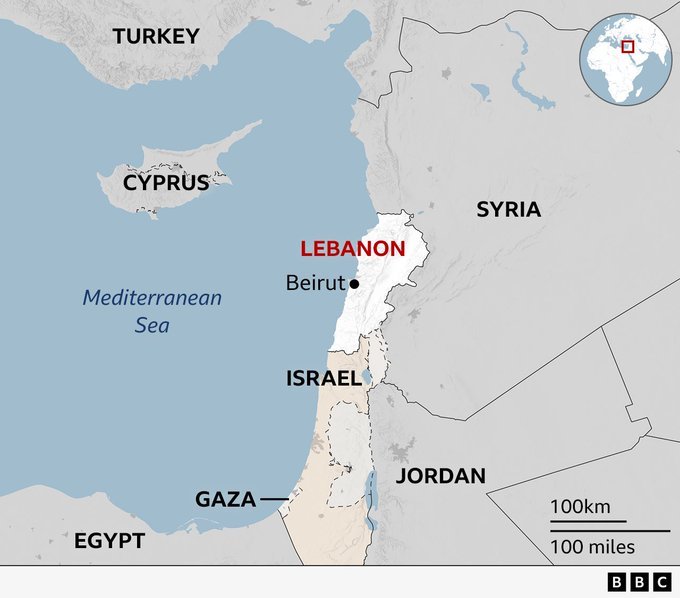
Hezbollah launched rockets and drones toward northern Israel early Monday, calling it retaliation for the killing of Iran’s Supreme Leader Ayatollah Ali Khamenei in U.S.-Israeli strikes. Israel responded with airstrikes on Hezbollah targets in Beirut’s southern suburbs, marking the first major breach of the 2024 ceasefire.
BY PC Bureau
March 2, 2026: The escalating conflict in the Middle East has taken a dramatic turn, with Hezbollah launching rockets and drones into Israel in direct retaliation for the recent killing of Iran’s Supreme Leader, Ayatollah Ali Khamenei. In response, Israeli forces carried out airstrikes on targets in Beirut’s southern suburbs, a stronghold of the Lebanon-based militant group.
The violence marks the first major breach of the U.S.-brokered ceasefire between Israel and Hezbollah since November 2024, raising fears of a broader regional war amid ongoing U.S.-Israeli military operations against Iran.
Khamenei’s Death Sparks Retaliation
Ayatollah Ali Khamenei, Iran’s supreme leader since 1989 and a central figure in the Islamic Republic’s opposition to Israel and the United States, was killed on February 28, 2026, during the opening phase of joint U.S.-Israeli airstrikes on Iran. The strikes targeted senior Iranian officials, Revolutionary Guard facilities, missile sites, and other military infrastructure in Tehran and elsewhere. Iranian state media confirmed Khamenei’s death, along with several family members and high-ranking officials, and declared 40 days of national mourning.
U.S. President Donald Trump announced the killing, describing Khamenei as “one of the most evil people in history” and suggesting it offered Iranians a chance to “take back their country.” The operation was aimed at degrading Iran’s nuclear and missile capabilities following stalled negotiations.
Iran responded with waves of missiles and drones targeting Israel and U.S. bases in the Gulf region, including Bahrain, Kuwait, Qatar, and sites in Saudi Arabia and the United Arab Emirates. Reports indicate that hundreds of projectiles were launched, many of which were intercepted, though some caused injuries and limited damage in Israel.
READ: Congress Condemns Khamenei Killing, Slams Modi Govt’s Silence
BREAKING:
🇮🇱🇮🇷🇱🇧 Lebanon has entered the chat
ROCKETS FIRED FROM LEBANON TOWARDS ISRAEL.
Hezbollah has joined the war after the death of Ayatollah Khamenei. pic.twitter.com/I7X1OUqrZf
— Megatron (@Megatron_ron) March 1, 2026
Hezbollah Enters the Fray
On March 2, 2026 (early Monday local time), Hezbollah claimed responsibility for firing a barrage of rockets and a swarm of drones toward Israel. The group said it specifically targeted a missile defense site near Haifa in northern Israel, describing the attack as “revenge for the blood of the Supreme Leader of the Muslims, Ali Khamenei,” and a defense of Lebanon against “repeated Israeli aggressions.”
This marked Hezbollah’s first confirmed strike on Israel since the 2024 ceasefire, which had ended more than a year of intense cross-border fighting. Hezbollah, Iran’s most prominent regional proxy, had previously mourned Khamenei at large rallies in Beirut’s southern suburbs, where thousands chanted anti-U.S. and anti-Israel slogans while waving Hezbollah and Iranian flags.
In its statement, Hezbollah characterized the attack as a “legitimate defensive response” and called for an end to what it described as U.S.-Israeli aggression.
Israeli Counterstrikes on Beirut
In immediate response, the Israel Defense Forces (IDF) launched airstrikes on Hezbollah targets across Lebanon, including in Beirut’s southern suburbs—known as Dahiyeh—a densely populated area long considered a Hezbollah stronghold. Explosions were reported in neighborhoods such as Haret Hreik and Jamous, with at least one confirmed strike in the suburbs. Lebanese security sources said buildings were hit, though initial assessments indicated no immediate casualties or major damage in some areas.
The IDF said the operations targeted Hezbollah infrastructure in retaliation for the rocket and drone assault. Sirens sounded in northern Israel following the incoming fire, but no injuries were immediately reported from Hezbollah’s attack.
Broader Implications
The exchange comes as U.S.-Israeli strikes on Iran continue into a second or third day, with Trump signaling the possibility of further operations while also expressing openness to talks with new Iranian leadership. A temporary three-member council has reportedly been formed in Iran to govern amid the leadership vacuum.
International reaction has been sharply divided. Russian President Vladimir Putin condemned Khamenei’s killing as a “cynical violation” of international norms, while some Iranian dissidents and expatriates welcomed the development. Global organizations and several governments have called for de-escalation, warning of the risk of wider instability.
Hezbollah’s involvement raises the prospect of Lebanon—still recovering from previous conflicts—being drawn back into full-scale war, potentially shattering the fragile post-2024 ceasefire and expanding the confrontation between the United States, Israel, and Iran across multiple fronts