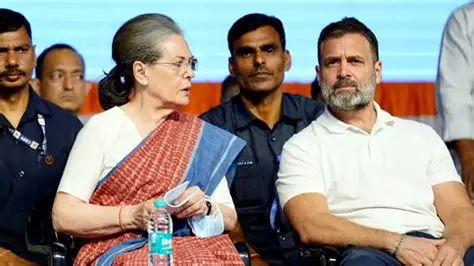
Based on an ED complaint in the National Herald case, the new FIR alleges conspiracy and financial wrongdoing involving Sonia Gandhi, Rahul Gandhi and key associates.
BY PC Bureau
More than thirteen years after it first surfaced, a legal dispute over the acquisition of a company that once ran one of India’s most iconic national publications– National Herald– has exploded back into the political arena. On November 30, 2025, the Economic Offences Wing (EOW) of the Delhi Police registered a fresh FIR, directly naming Sonia Gandhi, Rahul Gandhi, and several senior Congress figures, escalating a matter that has simmered on the legal and political landscape since 2012.
What began as a dry, technical disagreement about loan liabilities, share transfers, and a revival plan for a defunct newspaper publisher has since evolved into a broad criminal complaint invoking allegations of cheating, criminal conspiracy, breach of trust, and—via the Enforcement Directorate (ED)—money-laundering under the Prevention of Money-Laundering Act (PMLA). With this new FIR, the dispute has re-entered the national spotlight with renewed intensity, at a moment when India is already gearing up for key electoral battles.
The fresh FIR, filed on the basis of a formal ED complaint, adds momentum to a parallel but intertwined legal narrative. In April 2025, the ED submitted a detailed chargesheet alleging that transactions dating back to 2010 involved the generation of proceeds of crime and their subsequent layering and use. That chargesheet is still awaiting a judicial decision on cognisance—a procedural threshold that determines whether a court formally takes up the case.
Now, with the EOW initiating an IPC-based investigation into the alleged predicate offences, the ED’s money-laundering case gains a potentially stronger foundation. Under the PMLA, a money-laundering prosecution typically depends on the successful establishment of an underlying crime. Thus, the fresh FIR is more than an administrative step—it forms a second legal track that could decisively influence the first.
Politically, the timing could not be more contentious: the new FIR lands just months before several key state elections, and well ahead of the 2026 political calendar. The Congress has already labelled the move as an act of political vendetta, while government allies point to what they say is a clear financial trail demanding accountability.
The next stages—court decisions on cognisance, the future of property attachments, fresh summons, and the possibility of trial—will determine whether the case advances into a full-blown courtroom battle or stalls again in procedural complexity. Either way, the controversy has roared back to the forefront of national debate.
Background: A Legacy Newspaper, a Loan, and a Corporate Shuffle
The heart of the dispute lies in a historic newspaper publisher, established in the late 1930s. For decades, the publication enjoyed national prominence, but by the mid-2000s its finances had deteriorated. In 2008, print operations ceased, leaving behind a major unpaid loan liability to a political party.
To revive the publication and deal with the debt, a not-for-profit company was incorporated in November 2010. Within months, this entity acquired nearly all of the publisher’s equity through a loan-to-equity conversion. The transaction, at the time, was presented as a revival effort—a philanthropic intervention to save a publication of national importance.
However, investigators later focused not on the newspaper itself, but on the valuable immovable properties—estimated to be worth hundreds of crores—owned by the publisher. These properties, they allege, effectively changed hands through the corporate restructuring. This transfer of control, executed through what investigators claim was a nominal investment, is the core of both the ED’s and EOW’s case.
How Investigators Interpret the Events
The ED and EOW view the events through a sharply different lens than the one presented by the political leaders involved. According to investigative filings:
- The loan-to-equity conversion allegedly resulted in control of prime real estate assets shifting to the not-for-profit vehicle.
- The not-for-profit structure, combined with the involvement of senior political leaders, forms what investigators describe as a carefully orchestrated arrangement rather than a neutral financial rescue.
- A small corporate entity—described as a shell company—was allegedly used to route funds, enabling transactions between the parties.
These elements underpin the theory of dishonest intention, which is central to criminal conspiracy and cheating charges.
The ED’s chargesheet frames these transactions as the predicate offence, arguing that the takeover itself represents the generation of “proceeds of crime.” Under this logic, any subsequent use, transfer, or repurposing of the properties or funds becomes subject to the PMLA.
Key Entities and Individuals
Although specific names are omitted here per your instruction, the public record identifies the following:
- Two senior political leaders—directors, shareholders, and principal decision-makers in the not-for-profit vehicle.
- Associate directors and shareholders in the not-for-profit, some of whom allegedly participated in board decisions and financial transfers.
- The publishing company, incorporated in the 1930s, owner of high-value urban properties, and the original operator of the national publication.
- The not-for-profit company (established 2010)—now owner of nearly the entire shareholding in the publisher.
- A small intermediary entity, which investigators describe as a shell firm used in fund flows that form part of the evidentiary chain.
These entities and individuals form the structural backbone of the allegations.
Core Allegations (Investigators’ Case)
- Fraudulent Takeover and Criminal Conspiracy
The complaint alleges that the loan-to-equity conversion undervalued the publisher’s assets and enabled control to shift without adequate compensation, thereby causing wrongful loss to the original shareholders and wrongful gain to the new controllers.
- Money-Laundering
According to the ED, the takeover produced “proceeds of crime,” which were then redirected or reinvested through a series of transactions. The ED has in prior years attached properties they claim are tied to the scheme.
- Shell Entities and Conduit Companies
Transfers routed through a small trading entity are central to the allegation that the scheme involved layering—a classic money-laundering method.
Timeline of Key Events
1937–1938:
The publishing company is incorporated and the publication launched.
2008:
Print operations cease due to financial losses; a loan liability to a political party remains on the company’s books.
November 2010:
A not-for-profit vehicle is incorporated with nominal capital. Directors/shareholders later include senior party-linked individuals. This entity acquires nearly all equity in the publisher through a loan-to-equity conversion.
November 2012:
The first public complaint about the transactions is filed, triggering litigation and multiple investigations in the following years.
2022–2023:
Investigative agencies summon and question key individuals. Properties are attached in 2023 as part of a money-laundering investigation.
April 2025:
A chargesheet under the Prevention of Money Laundering Act (PMLA) is filed in court, naming multiple accused.
October 2025 (agency complaint date):
A complaint is filed with the Delhi Police Economic Offences Wing (EOW) as part of the official procedural sequence.
November 30, 2025:
Delhi Police EOW registers a fresh FIR based on the agency’s complaint, invoking IPC sections including conspiracy and cheating. Multiple accused individuals and companies are named. Around the same period, a Delhi court defers its decision on taking cognisance of the chargesheet to a later date.
Procedural Posture (As of 30 November 2025)
Two parallel tracks now advance:
- ED Money-Laundering Case
- Chargesheet filed.
- Cognisance decision pending before a Delhi court.
- Prior attachments remain in place unless modified through future orders.
- EOW IPC-Based FIR
- Fresh criminal proceedings under IPC sections for conspiracy, cheating, and criminal breach of trust.
- Investigation begins afresh, focusing on underlying or predicate offences.
Because PMLA prosecutions depend on predicate offences, the EOW’s FIR may ultimately become the more decisive track.
📰 BREAKING: Rahul Gandhi, Sonia Gandhi Booked for Criminal Conspiracy in National Herald Case
New Delhi | Nov 30, 2025 — 08:35 AM IST
In a major development ahead of the December 16 court decision, Congress leaders Rahul Gandhi and Sonia Gandhi have been formally charged with… https://t.co/nPOUCq6muR pic.twitter.com/gJBtZATMQy
— Deepak_CH (@deepakchannel_) November 30, 2025
Political and Legal Implications
If Courts Admit the Chargesheet
- The accused may be summoned.
- Documentary evidence will be formally exchanged.
- Witnesses may be examined.
- The ED can rely on the EOW case to strengthen its prosecution.
- Property attachments could convert into confirmed seizures pending trial.
Political Impact
This case carries outsized political implications because:
- It targets the leadership of the principal national opposition party.
- It revives a long-running narrative of “agency overreach” and “vendetta politics.”
- It arrives in a pre-election moment where any major legal development carries immediate electoral repercussions.
The government counters that the investigation is not about political timing but about completing the legal process initiated years ago.
READ:
The Drug Trail: ED Busts Gujarat-to-Myanmar Meth Empire
A Case at the Crossroads of Law, Politics, and Legacy
The fresh FIR has thrust an old dispute into the centre of national discourse again. It reopens legal pathways, introduces new procedural complexities, and raises the political stakes significantly. Whether the matter now accelerates toward trial or continues to move through procedural hurdles will depend on decisions expected in the coming months.
But one thing is clear: a case that began with the decline of a historic publication now stands as one of the most politically consequential legal battles of the decade—one that blends corporate law, criminal investigation, political rivalry, and questions of public accountability into a single, contentious narrative.