The contrast between raging protests across the hills and Nemcha Kipgen’s hometurf Kangpokpi’s eerie calm has exposed a deeper fault line in Manipur — the uneasy coexistence of democratic politics and entrenched militant authority shaping public life.
BY Navin Upadhyay
February 6, 2026: When large parts of Manipur’s Kuki-Zo hill districts erupted in sustained protests against three Kuki-Zo MLAs — including newly appointed Deputy Chief Minister Nemcha Kipgen — for joining the reconstituted state government, Kangpokpi, her home constituency, stood apart in an unsettling calm.
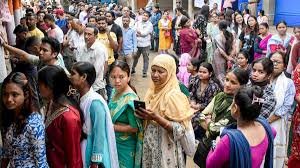
While mass demonstrations, shutdowns, torchlight marches and public denunciations swept across Churachandpur, Pherzawl, Tengnoupal and parts of Chandel, life in Kangpokpi appeared to continue almost normally. Shops remained open, traffic flowed, government offices functioned, and no significant protest activity was recorded.
To outside observers, the absence of unrest suggested acceptance, even endorsement. But local residents, civil society members, and political observers say the silence concealed something far more troubling — fear, enforced conformity, and the pervasive influence of armed power.
READ: On Camera: Hooded Gunman Walks Up to AAP Leader’s Car, Shoots Him Dead
“This is not peace,” said a Kangpokpi-based civil society activist, requesting anonymity. “This is silence produced by fear. Here, everyone understands what happens if you speak too loudly.”
Kangpokpi occupies a unique position in Manipur’s volatile hill politics. It is the power base of the United People’s Front (UPF) — an umbrella organisation representing seven to eight Kuki militant outfits operating under the Suspension of Operations (SoO) agreement signed with the Centre and the state government in 2008.
At the heart of this structure stands Seminthang Kipgen, chairman of the UPF and leader of the Kuki National Front–Presidential (KNF-P) faction, one of the most formidable armed groups in Manipur’s hills. According to official government submissions, the UPF commands around 1,000 armed cadres, stationed in designated camps but retaining their weapons, command structures, and territorial networks.
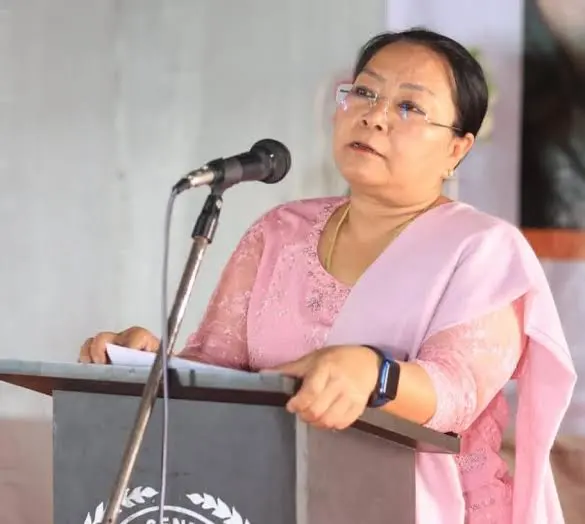
Seminthang Kipgen is also the husband of Deputy Chief Minister Nemcha Kipgen — a convergence of militant authority and constitutional power that analysts say has dramatically altered Kangpokpi’s political landscape.
📍Tuibong
Thousands of angry Kuki community members protest against certain Kuki-Zo MLAs for their participation in the formation of the popular Govt. in Manipur.@LokBhavManipur @HMOIndia @PMOIndia @ANI @PTI_News @the_hindu @thewire_in @ThePrintIndia @BDUTT @meipat @vijaita pic.twitter.com/Yn5MVmRKgI— Sumkawn (@Sumkawn) February 6, 2026
In this environment, public dissent becomes fraught.
Residents describe a district where armed presence is normalized, extortion networks are entrenched, and local governance operates under invisible but unmistakable pressure. Contractors, transporters, traders and even government project workers routinely pay what are locally called “taxes” to multiple armed factions.
“In other districts, people protest because they feel they have nothing left to lose,” said a community elder. “In Kangpokpi, people stay quiet because they feel they have everything to lose.”
The Trigger: A Political Crossing
The protests across Manipur’s hill districts were triggered by the decision of three Kuki-Zo MLAs — Nemcha Kipgen, Letpao Haokip, and Chinlunthang Guite — to join the new Manipur government after the lifting of President’s Rule.
For large sections of the Kuki-Zo population, this step represented a political betrayal. Since the outbreak of ethnic violence in May 2023, the dominant demand of Kuki-Zo civil society groups has been for a separate administration or Union Territory carved out of Manipur’s hill areas, arguing that coexistence with the Meitei-majority valley had become impossible.
Joining a Meitei-dominated government, therefore, was seen as legitimising the existing state structure, diluting bargaining power, and undermining the collective political struggle.
Across Churachandpur, Pherzawl and Tengnoupal, protesters carried placards reading “ Nemcha Kipgen is a Traitor” , “No Political Settlement Without Separate Administration”, and “We Reject Token Power”. In Delhi, Kuki-Zo demonstrators accused the MLAs of “selling out” the movement.
Yet in Kangpokpi — Nemcha Kipgen’s own constituency — no such mobilisation took place.
The Architecture of Control
The explanation, locals say, lies in the overwhelming dominance of the UPF network.
The KNF, founded in 1988 during the violent Kuki-Naga ethnic clashes, fractured into multiple factions in the mid-1990s. Seminthang Kipgen emerged as leader of the KNF-P, later positioning it as the dominant faction within the UPF coalition. Under the SoO agreement, the group formally entered peace talks, but retained effective territorial control in key hill districts.
Security officials acknowledge that UPF-linked groups continue to wield extra-constitutional authority — regulating transport, controlling trade routes, influencing contractor networks, and intervening in local disputes. While overt violence has declined under the ceasefire, coercive capacity remains intact.
“The guns are not visible on the streets, but everyone knows where they are,” said a local journalist. “That knowledge alone disciplines public behaviour.”
In Kangpokpi, where UPF camps are concentrated and Seminthang Kipgen’s personal authority is strongest, the boundaries of permissible political expression are sharply drawn.
Power Meets Politics
Seminthang Kipgen’s influence has expanded significantly since Nemcha Kipgen’s rise within the BJP . Analysts describe this convergence of armed leadership, ethnic authority and constitutional office as producing a shadow governance structure, particularly visible in Kangpokpi. Here, state institutions — police, administration, development agencies — operate cautiously, aware of the delicate balance of power.
“This is not classical insurgency,” said a senior security official. “It is a negotiated dominance — where militant groups coexist with the state, but retain decisive informal control.”
This hybrid authority explains why protests flourished elsewhere but stalled in Kangpokpi.
The Silence That Speaks
For civil society leaders, Kangpokpi’s stillness is itself a political statement — one that exposes the limits of democratic expression in militarised spaces.
“Where guns regulate social order, elections alone cannot guarantee freedom,” said a senior activist based in Churachandpur. “Kangpokpi shows how democratic choice collapses when armed power becomes permanent.”
As Manipur struggles to recover from nearly three years of ethnic violence, the contrasting responses across the hill districts reveal a deep structural dilemma: how to reconcile peace agreements that institutionalise armed groups with democratic governance that requires free political participation.
Kangpokpi’s silence, many fear, is not temporary. It is the sound of a parallel authority consolidating itself — quietly, efficiently, and beyond public scrutiny.