U.S. officials say the carrier movement is precautionary, aimed at deterrence and preparedness, even as Pentagon weighs military, cyber, and psychological options against Tehran.
By PC Bureau
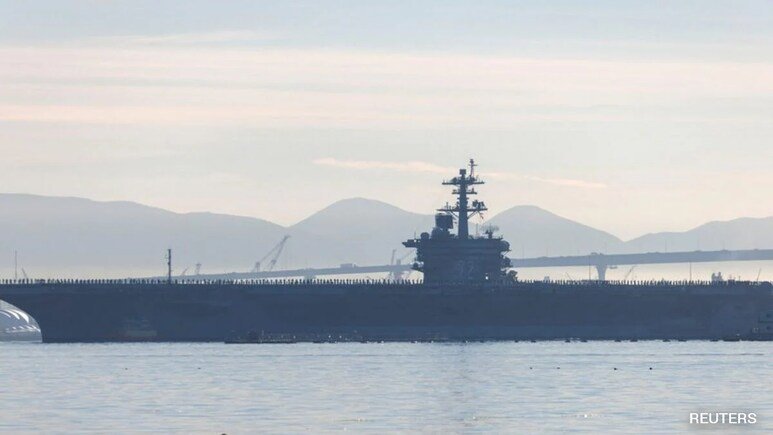
January 15, 2024: The Pentagon has confirmed the redeployment of a U.S. carrier strike group from the South China Sea to the U.S. Central Command (CENTCOM) area of responsibility, which includes the Middle East, amid escalating tensions between the Trump administration and Iran.
The move comes as Iran faces widespread anti-government protests now entering their third week, driven by record-high inflation, economic collapse, currency devaluation, and growing public anger over the regime’s governance and crackdown on dissent.
Citing defence officials and sources, multiple reports—including from NewsNation—said the strike group, centred on the nuclear-powered aircraft carrier USS Abraham Lincoln, along with guided-missile destroyers and other support assets—likely including at least one attack submarine—is currently en route. The transit across the Indian Ocean to the Arabian Sea is expected to take about a week at standard cruising speeds, potentially positioning the carrier group in the region by late January 2026.
READ: Iran Reopens Airspace as Protests Ease, Internet Still Down
READ:SC issues Notice to Mamata, Bengal Govt Over ED Probe
The redeployment marks a significant shift in U.S. naval posture, filling a gap left by the absence of any carrier strike group in the Middle East in recent months. While U.S. officials have not publicly outlined specific operational objectives, the move signals heightened readiness and deterrence rather than preparation for immediate limited action.
CENTCOM’s area of responsibility spans more than four million square miles across Northeast Africa, the Middle East, Central Asia, and South Asia, covering 21 countries, including Egypt, Iraq, Afghanistan, Iran, and Pakistan.
As part of precautionary measures, some personnel at Al Udeid Air Base in Qatar—the largest U.S. military installation in the Middle East, hosting around 10,000 troops—have been advised to depart as part of what officials described as a “change of posture.” U.S. authorities stressed the move was precautionary and not prompted by an imminent threat. The U.S. Embassy in Saudi Arabia has also urged personnel to exercise increased caution, limit non-essential travel to military facilities, and maintain updated personal security plans.
Regional governments have reportedly expressed concern that any U.S. military action could further destabilise the Middle East, triggering broader security and economic repercussions. Several countries are said to have conveyed these concerns directly to the Trump administration.
On the political front, President Donald Trump has been briefed on a range of military, cyber, and psychological options against Iran that extend beyond conventional airstrikes. As protests continue, Washington has issued warnings over Tehran’s handling of demonstrators. Trump has publicly stated that “help is on its way” to protesters and claimed recent intelligence suggests the regime has halted killings, with no immediate executions planned, though officials caution the situation remains fluid.
The protests, which erupted in late December 2025 over severe economic distress—including inflation exceeding 40 per cent, food prices rising 72 per cent year-on-year, and a sharp collapse of the rial—have since evolved into nationwide calls for regime change. Demonstrators have openly targeted Supreme Leader Ayatollah Ali Khamenei, with some expressing support for exiled figures such as Reza Pahlavi. Unrest has spread across all provinces, involving bazaar traders, university students, and ordinary citizens.
According to figures from the Human Rights Activists News Agency (HRANA) and other activist groups, the crackdown has resulted in significant casualties, including live fire incidents, mass arrests, and a prolonged internet blackout. Activist estimates of deaths vary widely—from several hundred to over 2,000 during intensified phases—while tens of thousands are reported to have been arrested and many injured. Independent verification remains difficult due to severe communications restrictions, and Iranian authorities have not released official civilian casualty figures.
The carrier redeployment and broader U.S. posture underscore the increasingly volatile intersection of Iran’s domestic crisis and regional geopolitics under the Trump administration.