From a provocative painting to photographs with Ghislaine Maxwell, the Epstein files shed new light on the social world Epstein cultivated, placing powerful figures like Bill Clinton uncomfortably close to a scandal that continues to unravel.
BY PC Bureau
The unsealing of fresh documents under the Epstein Files Transparency Act has once again thrust former US president Bill Clinton into an uncomfortable spotlight, reviving images, photographs, and associations that have lingered on the fringes of public discourse for years. While the files do not allege criminal wrongdoing by Clinton, they deepen scrutiny of his proximity to Jeffrey Epstein and Epstein’s convicted accomplice Ghislaine Maxwell—a proximity that Clinton himself has described as a profound misjudgment.
The Painting That Became a Symbol
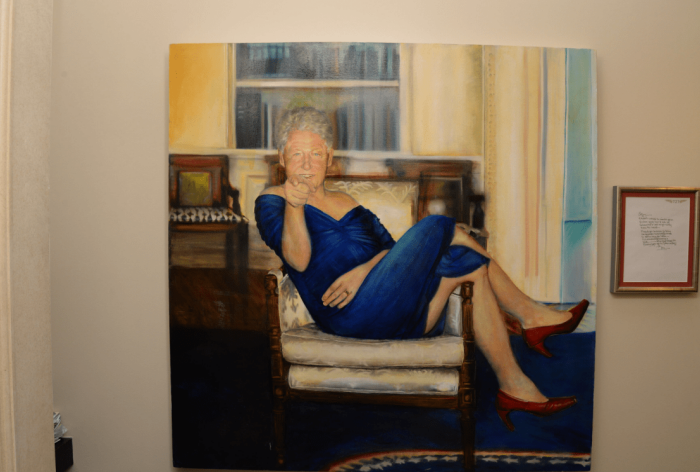
Among the most arresting revelations is the resurfacing of a painting depicting Bill Clinton wearing a dress and red high heels. The artwork, long rumored to exist within Epstein’s properties, has now gained renewed attention as part of the broader documentary record tied to Epstein’s estate and investigations.
The painting has become symbolic—not as evidence of illegality, but as a visual metaphor for the strange, unsettling world Epstein cultivated, where power, wealth, celebrity, and transgression blurred into spectacle. Its re-emergence underscores how Epstein collected not just people, but symbols of influence, often in provocative or compromising forms.
Photographs That Fuel Scrutiny

( Bill Clinton in a swimming pool with convicted sex trafficket Ghislaine Maxwell)
The files also reference multiple photographs featuring Clinton in Epstein-linked settings. These include images of Clinton with Ghislaine Maxwell at the Winston Churchill War Rooms in London, a historically significant site whose appearance in the Epstein narrative only amplifies public unease.

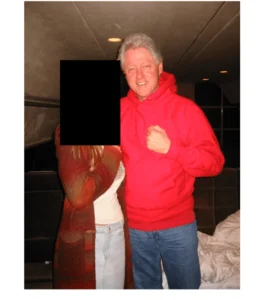
Other photographs reportedly show Clinton in a hot tub, and in another instance, posing with a woman whose face has been redacted by the US Department of Justice to protect privacy. In yet another image, Clinton is seen in a swimming pool with Maxwell, reinforcing documented social familiarity between the former president and Epstein’s inner circle.
Again, the DOJ has stressed that appearance in photographs or documents does not imply criminal conduct, a caution echoed by legal experts reviewing the files.
Clinton’s Own Words: Regret and Distance
Clinton has not denied knowing Epstein, nor has he sought to minimize the political cost of that association. In his 2024 memoir, Citizen: My Life After the White House, he addressed the issue directly:
“The bottom line is, even though it allowed me to visit the work of my foundation, travelling on Epstein’s plane was not worth the years of questioning afterward. I wish I had never met him.”
The statement reflects an acknowledgment that, while no charges have ever been brought against Clinton in connection with Epstein, the optics and judgment involved continue to haunt his post-presidency.
Bill Clinton with woman in jacuzzi in latest Epstein files Justice Dep photo dump
We can safely assume it’s not Hillary pic.twitter.com/3kur3Xk0qE
— Ignorance, the root and stem of all evil (@ivan_8848) December 20, 2025
READ: Epstein Files Bombshell: Prince Andrew Lying Across Women, Sex Toys, Dark Secrets
Epstein’s Strategy: Access, Prestige, Silence
Investigators and journalists have long argued that Epstein’s power lay less in overt coercion and more in curated proximity—placing himself near presidents, princes, billionaires, and intellectuals. Clinton’s presence in Epstein-linked photographs fits this broader pattern, in which Epstein leveraged elite access to shield himself from scrutiny for years.
Epstein’s ability to host, photograph, and associate with powerful figures created a protective fog—one that discouraged questions and delayed accountability until it was too late for many victims.
Legal Reality vs Public Judgment
Crucially, no document released so far accuses Clinton of participating in Epstein’s crimes. Several men named or depicted in the files—including Clinton—have consistently denied any involvement in Epstein’s illegal activities. Legal experts caution that conflating association with guilt risks undermining due process.
Yet public judgment operates differently. For many, the Epstein files are not only about criminal liability but about moral accountability, elite privilege, and how power insulated Epstein for decades.
A Political and Cultural Aftershock
The renewed focus on Clinton comes at a politically charged moment in the United States, where trust in institutions and elites remains fragile. Each new release fuels debate about who knew what, when, and why warnings were ignored.
For Clinton, the Epstein files represent a lingering stain on an otherwise storied political legacy—not because of proven wrongdoing, but because of closeness to a man now synonymous with exploitation and abuse.
The Unanswered Question
As more documents are expected to be released in the coming weeks, the Clinton-Epstein connection remains emblematic of a larger, unresolved question: how did so many powerful figures pass through Epstein’s orbit without stopping him?
The files may never provide a complete answer. But they ensure that the questions—once whispered—are now permanently on the record.