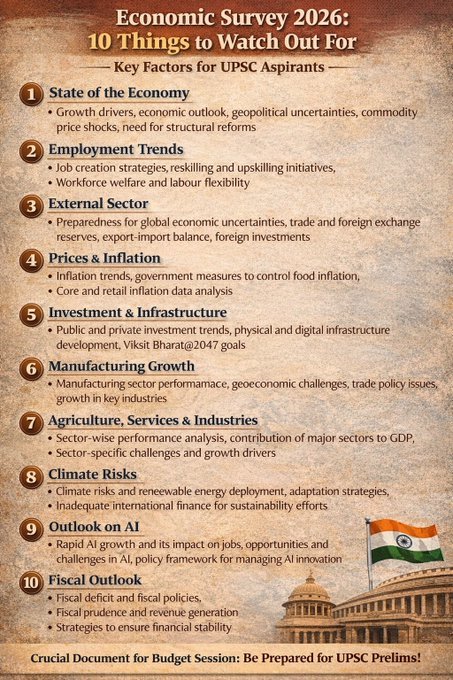
The Economic Survey 2026 struck a note of cautious optimism, projecting robust growth while warning that geopolitical tensions, weak global demand, and tight financial conditions could pose challenges.
New Delhi | January 29, 2026
The Economic Survey 2025–26, tabled in Parliament on Thursday by Finance Minister Nirmala Sitharaman, presented a cautiously optimistic assessment of India’s economic trajectory, projecting real GDP growth of 6.8% to 7.2% for FY27, while flagging elevated global uncertainties as key downside risks.
The Survey underscored that domestic demand remains the principal engine of growth, with strong consumption—particularly in urban centres—continuing to anchor economic momentum. Tax rationalisation measures implemented in recent years have further boosted household spending, reinforcing demand-led expansion.
Looking ahead, the Survey reaffirmed that India’s medium-term growth outlook remains robust, supported by sustained structural reforms, macroeconomic stability, rising public investment, and improving private sector confidence. Together, these factors have strengthened economic fundamentals and enhanced resilience against external shocks.
Union Finance Minister @nsitharaman tables the Economic Survey 2025-26 in Lok Sabha during the Budget session of Parliament#EconomicSurvey #EconomicSurvey2025_26 #BudgetSession #BudgetSession2026 pic.twitter.com/tj4awKzsfi
— PIB India (@PIB_India) January 29, 2026
\Drawing from recent discussions and official updates on X (as of January 29, 2026), here’s a clean summary of the major takeaways from the Economic Survey 2025-26 (covering FY26), tabled by Finance Minister Nirmala Sitharaman earlier today. These reflect widely shared insights from analysts, official handles, and economic observers:
GDP Growth Projections
- FY26 (current fiscal year): Real GDP growth estimated at 7.4% (First Advance Estimates), exceeding prior projections and confirming India as the fastest-growing major economy for the fourth consecutive year.
- FY27: Projected at 6.8-7.2%, indicating steady expansion supported by strong domestic demand, investment momentum, and ongoing reforms, even amid global uncertainties. Medium-term potential remains around 7%.
Macroeconomic Stability & Fiscal Health
- Fiscal deficit has been significantly reduced as a share of GDP since the pandemic, paired with higher-quality public expenditure and increased infrastructure investment.
- Inflation outlook remains contained and benign, aided by favorable supply conditions and tax rationalization measures.
External Sector & Trade
- Emphasis on building export competitiveness for a more robust and stable rupee, drawing from historical patterns of manufacturing-led export success in other economies.
- Recent India-EU FTA (concluded recently) opens major opportunities, with duty-free access for a large share of Indian exports to a combined market of about 2 billion people.
Sectoral Achievements
- Electronics/Manufacturing: India has transformed into the world’s second-largest mobile phone producer, with factory numbers rising dramatically and output value surging nearly 30-fold over the past decade.
- Telecom: Signs of import substitution emerging, with exports growing modestly while imports decline sharply—aligned with PLI scheme goals.
- Broader industrial momentum visible in recent data, including strong growth in manufacturing, mining, electricity, and consumer goods sectors.
Global Context
- Global environment described as fragile with high uncertainty (geopolitical flux, trade tensions), yet India’s external stability stands out as a key strength. Outlook calls for caution without pessimism, positioning FY27 as a year of adaptation with domestic drivers gaining traction.
Broader Themes
- Focus on long-term economic transformation, job creation, foreign investment attraction, and fiscal discipline ahead of the Union Budget.
- Highlights prudent policymaking, reform continuity, and India’s structural shift toward higher growth under current leadership.
The full document is available on the official site: indiabudget.gov.in/economicsurvey/index.php (post-tabling). These points capture the core narrative circulating on X from credible economic and policy-focused accounts, emphasizing resilience and optimism despite external challenges.
READ: Gold Crosses ₹1.75 Lakh, Silver Tops ₹4 Lakh Amid Global Turmoil
READ: Ajit Pawar Laid to Rest With Full State Honours in Baramati
Global Risks Remain Elevated
While acknowledging that recent growth outcomes have exceeded expectations, the Survey cautioned that downside risks remain elevated due to fragile global conditions. Key challenges highlighted include:
Rising geopolitical tensions
Volatile commodity prices
Tight global financial conditions
Weak global demand
These factors could weigh on external trade, capital flows, and financial market stability. Nevertheless, the Survey maintained a positive overall assessment, citing solid domestic fundamentals, stable external indicators, improving export competitiveness, and reform momentum as key buffers against global volatility.
Despite these headwinds, Chief Economic Adviser V. Anantha Nageswaran highlighted that macro stability, fiscal consolidation, and rising capital expenditure have significantly strengthened economic resilience. He noted that the fiscal deficit has nearly halved as a share of GDP since the pandemic, while infrastructure investment and expenditure efficiency have improved substantially.
Rupee Under Pressure, Capital Flows Key Factor
Explaining the rupee’s recent weakness, the Survey said the currency has been primarily impacted by reduced foreign capital inflows and heightened global risk aversion. It noted that the rupee underperformed in 2025 largely due to capital outflows and dollar strength, rather than domestic macroeconomic fragility.
The Survey emphasised that export competitiveness and manufacturing strength are critical for achieving long-term currency stability, pointing to international experience where sustained export surpluses helped establish stable and resilient currencies.
Trade Deals: Opportunity Hinges on Competitiveness
On trade agreements, including the recently concluded India–EU Free Trade Agreement, the Survey stressed that realising the full benefits of FTAs depends on India’s ability to produce competitively at scale.
With 93% of Indian shipments gaining duty-free access to the EU market, the deal opens major opportunities for manufacturing exports. However, the Survey highlighted the need for logistics efficiency, regulatory simplification, quality upgradation, and productivity enhancement to fully capitalise on these trade openings.
Why the Economic Survey Matters
Often described as the government’s annual economic “report card,” the Economic Survey provides the analytical foundation for the Union Budget, which Finance Minister Sitharaman will present on February 1, 2026 — her ninth consecutive Budget, a rare milestone in Indian fiscal history.
Prepared by the Department of Economic Affairs under the Chief Economic Adviser, the Survey is released in two volumes:
Volume I: Macro assessment, growth outlook, fiscal trends, inflation, trade, and reforms
Volume II: Sector-wise performance of agriculture, industry, services, infrastructure, and social sectors
The Economic Survey 2026 strikes a measured and balanced tone, projecting confidence in India’s growth story while urging vigilance amid global uncertainty. With domestic demand, reforms, infrastructure investment, and manufacturing transformation as key pillars, the Survey sets a constructive backdrop for Budget 2026.