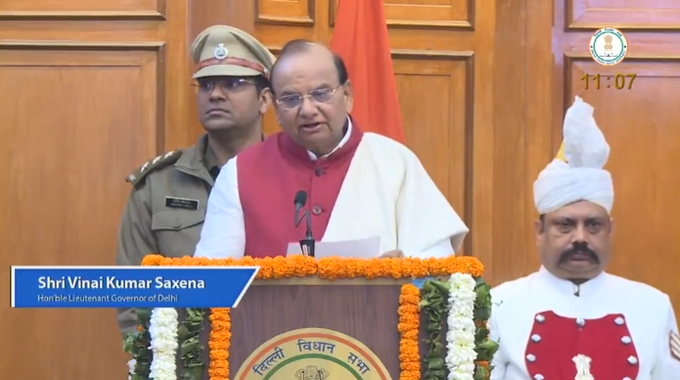
Addressing the House, Lt Governor Saxena said the government was focused on restoring efficiency, transparency and accountability, while doubling capital expenditure to nearly ₹28,000 crore and prioritising sectors such as health, education, transport, environment and social welfare.
BY PC Bureau
New Delhi, January 6, 2026 — The fourth session of the Eighth Delhi Legislative Assembly commenced on Monday with Lt Governor V.K. Saxena addressing the House, presenting a comprehensive account of the government’s achievements over the past ten months and laying out an ambitious roadmap for governance reforms, infrastructure expansion, social welfare delivery and environmental sustainability in the national capital.
Welcoming legislators to the session, Saxena said the government had been entrusted with a strong public mandate and was focused on reversing what he described as years of policy stagnation through decisive administration, institutional reform and a results-oriented approach. He emphasised that the government’s priority was to restore efficiency, transparency and accountability across departments while accelerating development work.
READ: Trump Parades Maduro in Open Van Through New York Streets
A key highlight of the address was the presentation of what the Lt Governor termed a “historic” ₹1 lakh crore budget for the financial year 2025–26. The budget, he said, was anchored around ten priority sectors — infrastructure, education, health, women’s welfare, electricity, water supply, roads, environment, industrial development and social justice. Capital expenditure has been doubled to nearly ₹28,000 crore, reflecting the government’s intent to invest heavily in long-term assets and urban infrastructure to make Delhi a future-ready global capital.
Delhi Lieutenant Governor Vinai Kumar Saxena, during his address to the Delhi Legislative Assembly Winter Session, stated that “this year, the government has allocated a budget of ₹ 1 lakh crore, focusing on all 10 key priority sectors.” These sectors include infrastructure,… pic.twitter.com/etl2iUqNiq
— DD News (@DDNewslive) January 5, 2026
On governance and ease of doing business, Saxena outlined a series of administrative reforms aimed at simplifying procedures and reducing compliance burdens. These included rationalisation of licensing norms, streamlining of labour regulations, integration of 75 e-district services with citizen service centres, and the rollout of e-office systems across government departments. He also noted that commercial establishments, barring liquor outlets, have been permitted to operate 24×7 to boost economic activity and employment. In coordination with the Centre, 29 labour laws have been subsumed into four labour codes to create a more transparent and employer-friendly regulatory framework.
Healthcare emerged as a major focus area, with Saxena stating that 13 per cent of the total budget allocation has been earmarked for the sector. He highlighted the implementation of the Ayushman Bharat–Pradhan Mantri Jan Arogya Yojana (PMJAY) in Delhi, under which over 6.7 lakh health cards have been issued, including more than 2.6 lakh cards for senior citizens above the age of 70. As of now, 188 hospitals have been empanelled under the scheme, and nearly 19,300 patients have already received treatment. The Lt Governor also spoke of ongoing hospital expansion projects, augmentation of ambulance services, the establishment of new dialysis centres, and the launch of a dedicated brain health clinic in Dwarka. Strengthening of primary healthcare through Ayushman Arogya Mandirs was cited as a key step towards preventive and community-based healthcare.
In the education sector, which accounts for 19 per cent of the budget allocation, Saxena said the government had undertaken structural reforms to improve transparency, access and quality. He referred to the enactment of the Delhi School Education (Transparency in Fixation and Regulation of Fees) Act to regulate school fees, along with initiatives such as the establishment of Dr APJ Abdul Kalam Language Laboratories, the launch of CM SHRI schools, smart classrooms, upgraded IT labs and free laptops for meritorious students. Sports promotion also received special attention, with incentives for athletes significantly enhanced, including cash awards of up to ₹7 crore for Olympic gold medallists.
Infrastructure and transport projects formed another major pillar of the address. Saxena highlighted the induction of more than 3,500 electric buses into Delhi’s public transport system, expansion of electric vehicle charging infrastructure, and funding support for Metro Phase-IV. He cited the renovation and redevelopment of arterial roads, completion of long-pending flyovers, and receipt of central assistance for major road and connectivity projects. To address chronic waterlogging, the government has initiated large-scale drainage works and prepared Delhi’s first comprehensive drainage master plan in nearly five decades.
On environmental protection, the Lt Governor said the government had adopted a year-round approach to tackling air pollution, moving beyond seasonal responses. Measures include expansion of air quality monitoring infrastructure, increased deployment of electric buses, strengthening of waste management systems, biomining of legacy landfills, and accelerated efforts to rejuvenate the Yamuna river. Tree plantation drives, promotion of solar energy, and stricter enforcement against industrial and vehicular pollution were also underlined.
Saxena also detailed a range of social welfare initiatives, including slum redevelopment projects, expansion of Atal Canteens providing nutritious meals at ₹5, financial assistance to construction workers affected by pollution-related work stoppages, and enhanced pension support for persons with disabilities. He referred to rehabilitation measures for victims of the 1984 anti-Sikh riots and the implementation of the PM SWAMITVA scheme to provide property ownership records in Delhi’s rural areas.
Concluding his address, the Lt Governor urged members of the Assembly to engage in constructive debate, uphold democratic values and work collectively in the interest of Delhi’s residents. Expressing confidence in the House’s deliberations, Saxena said the session would play a crucial role in shaping policies that align with public aspirations and ensure inclusive, sustainable development for the national capital.