BY PC Bureau
December 7, 2025 – China’s powerful national security office in Hong Kong summoned representatives from at least five international news organizations on Sunday and issued a chilling warning: stop “smearing” the government’s handling of last week’s deadly fire in a public housing tower or face consequences, reports The New York Times.
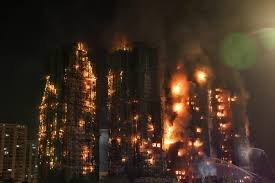
The rare, direct confrontation with foreign media came after overseas outlets — including The New York Times, BBC, Reuters, Agence France-Presse, and the South China Morning Post — published reports highlighting slow emergency response times, locked rooftop exits, and the deaths of at least 46 residents, most of them elderly or disabled, in the November 30 inferno at a 38-story block in Kwun Tong district.
In a four-sentence statement posted to its official WeChat account late Sunday, the Office for Safeguarding National Security of the Central People’s Government in the HKSAR accused “some foreign media” of “maliciously attacking the Hong Kong SAR government and police” and “hyping so-called ‘human rights issues’ to interfere in Hong Kong affairs.”“Do not underestimate the firm determination of the Hong Kong SAR to safeguard national security,” the statement concluded. “Do not say you have not been warned.”
🚨 In line with the CCP’s playbook, Hong Kong authorities are aggressively doing everything they can to chill speech related to the fire that had killed 159 so far, and 🇭🇰 Secretary for Security Chris Tang has just slammed this very WSJ editorial.
A couple of social media… pic.twitter.com/GlxzbObL8B
— Byron Wan (@Byron_Wan) December 6, 2025
The NYT report said that the journalists who attended the closed-door meeting at the national security office’s headquarters in Causeway Bay described a tense 35-minute session. According to three people present who spoke on condition of anonymity because of fear of reprisals, a senior official read prepared remarks accusing the outlets of “distorting facts” and “acting as the mouthpiece of anti-China forces.”
No specific articles were named, but reporters were told their coverage had “crossed red lines.” One attendee said the official repeatedly used the phrase “severe legal consequences” while declining to elaborate on what measures might follow. Phones were required to be left outside the meeting room, and no recording was permitted, the NYT reported.
READ: IndiGo Crisis Revives Anger Over Manipur Airfare Loot
READ: What a Hoax: A Heartwarming Tale of Indian Teen and English Actress
The summons marks the first known instance of Beijing’s national security apparatus in Hong Kong directly hauling in foreign correspondents since the imposition of the 2020 National Security Law. Previous pressure on overseas media has typically come through the Hong Kong government’s Government Information Office or indirect visa delays.
The Kwun Tong fire has become a flashpoint for public anger. Video footage verified by multiple outlets showed residents trapped on upper floors waving mobile-phone flashlights for more than 40 minutes before firefighters gained access to certain stairwells. Relatives of victims and opposition lawmakers have demanded an independent inquiry into why some rooftop doors were chained shut — a practice outlawed after the 2017 Grenfell Tower disaster in London but reportedly still common in older public estates.
Hong Kong leader John Lee on Friday defended the emergency response as “professional and efficient,” while police have opened a criminal investigation into possible arson and obstruction of fire exits. Authorities have so far declined to release the full fire-safety inspection records for the building.
Press-freedom advocates immediately condemned Sunday’s move. “The phrase ‘do not say you have not been warned’ has historically preceded the harshest crackdowns in mainland China,” said a spokesperson for the Hong Kong Foreign Correspondents’ Club. “Summoning journalists to a national security office and threatening them for doing their jobs is a grave escalation.”
None of the five targeted news organizations have publicly commented on the meeting, but several are reviewing security protocols for their staff. Two veteran correspondents told The Times they are now weighing whether to send family members out of Hong Kong temporarily.
Since the 2020 security law took effect, at least 12 local media outlets have closed and more than 100 journalists have left the city. Foreign newsrooms have largely continued operating, though several have relocated some ethnic-Chinese staff to Taipei or Singapore after visa renewals were delayed or denied.
Beijing maintains that Hong Kong’s press freedom remains protected under the “one country, two systems” framework, provided reporting does not endanger national security.
Sunday’s warning, delivered on the fifth anniversary of the first arrests under the security law, served as a stark reminder that the boundaries of acceptable coverage have narrowed dramatically — and that even international media are no longer untouchable.