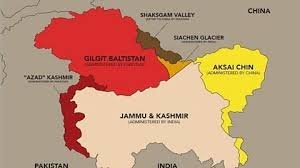
India has reiterated that it does not recognise the 1963 China-Pakistan Boundary Agreement, calling it illegal and invalid, and has protested CPEC-related work in the disputed Shaksgam valley.
PC Bureau
New Delhi, January 13, 2026 — India and China traded sharp words once again over the disputed Shaksgam Valley in the Kashmir region after Beijing rejected New Delhi’s territorial claims and defended its infrastructure activity in the area as a legitimate exercise of sovereignty.
Responding to India’s recent objections, Chinese Foreign Ministry spokesperson Mao Ning said on January 12 that the territory “belongs to China” and that infrastructure construction there was “fully justified” and “beyond reproach.” She maintained that China was undertaking development on its own land and dismissed India’s concerns as unfounded.
Mao reiterated that the China-Pakistan Boundary Agreement signed in the 1960s had legally demarcated the border between the two countries. She also defended the China-Pakistan Economic Corridor (CPEC), a flagship Belt and Road Initiative project, describing it as an economic cooperation framework aimed at promoting local development and improving livelihoods.
According to Mao, neither the boundary agreement nor CPEC alters China’s position on the broader Kashmir issue, which Beijing characterises as a historical dispute to be resolved peacefully in accordance with the UN Charter, relevant UN Security Council resolutions, and bilateral agreements between the parties concerned.
The Chinese remarks came in direct response to India’s strong protest lodged on January 9. Ministry of External Affairs (MEA) spokesperson Randhir Jaiswal asserted that Shaksgam Valley is “an Indian territory” and reiterated that New Delhi has never recognised the “so-called” 1963 China-Pakistan Boundary Agreement, under which Pakistan ceded control of the area to China.
Jaiswal described the agreement as “illegal and invalid,” along with any CPEC-related projects passing through what India considers Indian territory under Pakistan’s “forcible and illegal occupation.” He underlined that the Union Territories of Jammu and Kashmir and Ladakh are “integral and inalienable parts of India,” a position New Delhi has consistently conveyed to both China and Pakistan.
READ: From Code to Call Centres: AI’s Quiet Takeover of Indian Jobs
Breaking: China rejects India’s claim to Shaksgam Valley in Kashmir
“The territory you mentioned belongs to China. It’s fully justified for China to conduct infrastructure construction on its own territory,” says China’s Foreign Ministry pic.twitter.com/CMmyWvK4z5
— Shashank Mattoo (@MattooShashank) January 13, 2026
“We have repeatedly protested with the Chinese side against attempts to alter the ground situation in Shaksgam Valley,” Jaiswal said, adding that India reserves the right to take all necessary measures to safeguard its sovereignty and interests.
Also known as the Trans-Karakoram Tract, the Shaksgam Valley covers about 5,180 square kilometres and lies at a strategically sensitive junction. It borders China’s Xinjiang region to the north, Pakistan-occupied parts of Jammu and Kashmir, including Gilgit-Baltistan, to the south and west, and the Siachen Glacier region to the east—close to one of the world’s highest military theatres.
READ: Manipur: ITLF, UKNA Close Ranks for Jan 14 Union Territory Rally
Reports of China constructing all-weather roads and related infrastructure in the valley as part of CPEC expansion have heightened Indian concerns, with New Delhi viewing the activity as an attempt to change facts on the ground. Pakistan occupied the area following the 1947-48 conflict and transferred it to China under the 1963 agreement, which includes a provision for renegotiation pending a final settlement of the Kashmir dispute.
“Shaksgam Valley is Indian territory.
We’ve never recognised so called China-Pakistan boundary agreement of 1963. We also don’t recognise so-called China-Pakistan Economic Corridor which passes through INDIAN territory”- MEA spoxWill Jawahar like this statement? Afterall, he… pic.twitter.com/xU7qmRm4Mn
— BhikuMhatre (@MumbaichaDon) January 10, 2026
The latest exchange underscores enduring fault lines in India-China relations, already strained by the unresolved military standoff in eastern Ladakh since 2020 and sharp differences over regional connectivity initiatives such as CPEC. Neither side has shown any sign of softening its core territorial stance.
Analysts note that while China insists Kashmir is a bilateral issue between India and Pakistan, its role through the 1963 agreement and infrastructure activity keeps Shaksgam Valley a persistent flashpoint in a complex trilateral dynamic. The dispute reflects broader geopolitical competition in South Asia, where sovereignty claims, strategic corridors, and fragile border stability increasingly intersect.