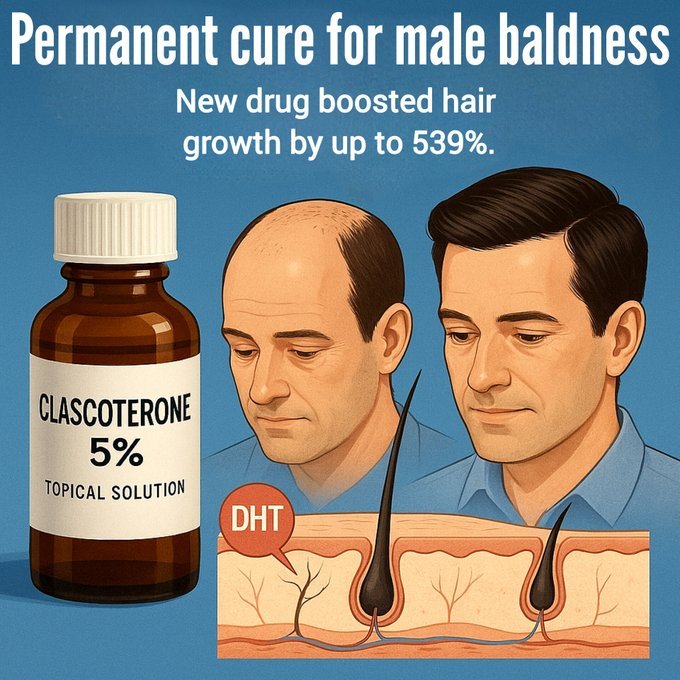
Phase III trials of the new drug confirm safety and efficacy, marking the first major advancement in androgenetic alopecia (Baldness) treatment in over 30 years.
BY PC Bureau
December 8, 2025: Male pattern baldness, clinically known as androgenetic alopecia (AGA), affects nearly 50% of men by age 50 and up to 80% by age 70, according to the American Hair Loss Association. Driven primarily by dihydrotestosterone (DHT)—a hormone that shrinks hair follicles—AGA often begins in men’s late 20s or early 30s, starting with subtle signs such as a receding hairline or thinning crown. Beyond physical appearance, hair loss can take a significant psychological toll, including reduced self-esteem, anxiety, and social withdrawal, studies in the Journal of the American Academy of Dermatology suggest.
For decades, treatment options like topical minoxidil, which stimulates blood flow to hair follicles, or oral finasteride, a DHT blocker, have offered partial relief—but both have limitations, ranging from modest regrowth to potential systemic side effects. Now, a promising new therapy, clascoterone 5% topical solution, is emerging as a potential game-changer.
Clascoterone 5%: The New Topical Androgen Blocker
On December 3, 2025, Ireland-based Cosmo Pharmaceuticals N.V. released topline results from its Phase III SCALP 1 (NCT05910450) and SCALP 2 (NCT05914805) trials, testing clascoterone 5% solution in men with mild-to-moderate AGA.
This is INSANE: Permanent cure for male baldness discovered
A new drug has delivered up to 539% more new hair growth in clinical trials, offering a breakthrough for men suffering from male pattern baldness.
In this treatment, a topical solution called Clascoterone 5% is applied… pic.twitter.com/Ft8bZ2TbVH
— SciTech Era (@SciTechera) December 7, 2025
These randomized, double-blind, vehicle-controlled trials enrolled 1,465 men aged 18–55 across 50 sites in the U.S., Germany, and Poland, making it the largest Phase III program for a topical AGA therapy to date. Participants applied the solution twice daily for six months, followed by an extension phase.
Primary endpoint: Target Area Hair Count (TAHC), measuring non-vellus hairs in a 1-inch circle on the balding crown.
Results:
- SCALP 1 (702 participants, U.S.): 168% improvement vs. placebo
- SCALP 2 (763 participants, U.S. + Europe): 539% improvement vs. placebo
Secondary endpoints—including patient satisfaction scores and global photographic assessments—also showed significant improvements in hair coverage and density.
“These data reflect a significant milestone for patients with male pattern hair loss. Clascoterone could change the treatment landscape by offering measurable regrowth without systemic side effects,”
—Dr. Maria Hordinsky, University of Minnesota.
READ: Modi Accuses Congress of Echoing Jinnah on Vande Mataram
READ: Hyderabad Plans Trump Avenue, Google Street, Microsoft Road
Safety Profile and Mechanism
Clascoterone was well-tolerated, with treatment-emergent adverse events (TEAEs) comparable to placebo. Unlike oral anti-androgens, it acts locally in the follicle, blocking DHT without systemic absorption—minimizing risks such as libido changes or mood effects.
The drug builds on the FDA-approved Winlevi® 1% cream (2020) for acne, which has a strong safety track record with over 1.4 million U.S. prescriptions.
Market Potential and Future Outlook
Following the announcement, Cosmo’s shares surged 40% on the SIX Swiss Exchange, reflecting optimism for the AGA market, projected to exceed $10 billion globally by 2030.
If approved, clascoterone could be the first new mechanism-based AGA therapy in over 30 years, offering hope to millions who avoid or discontinue oral treatments due to side effects. Full datasets for FDA and EMA submissions are expected by spring 2026, with potential market approval by late 2026 or early 2027.
Norwood Scale: Understanding AGA Progression
The Norwood-Hamilton Scale classifies male pattern baldness from stages 1–7:
- No recession – Juvenile hairline intact
- Slight recession – Mild temple thinning
- Moderate recession – “M/U/V” hairline; crown may thin
- Advanced recession – Hairline recedes, distinct crown spot
- Bridging loss – Frontal and crown areas connect
- Merger of bald areas – Large bald zone; sides/back stable
- Severe baldness – Horseshoe fringe; limited regrowth
Early intervention (stages 1–3) provides the highest chance of success with topical therapies. Advanced stages may require surgical interventions, such as follicular unit extraction (FUE).
Clascoterone 5% marks a major breakthrough in AGA treatment, offering clinically meaningful hair regrowth with minimal systemic risks. For men in early stages, it represents an opportunity to preserve existing hair and restore density, potentially transforming decades of stagnant treatment options into a new era of confidence and choice.