Opposition parties call it blatant bribery disguised as welfare, accusing the Election Commission of double standards for allowing cash transfers during the Model Code of Conduct.
By Navin Upadhyay
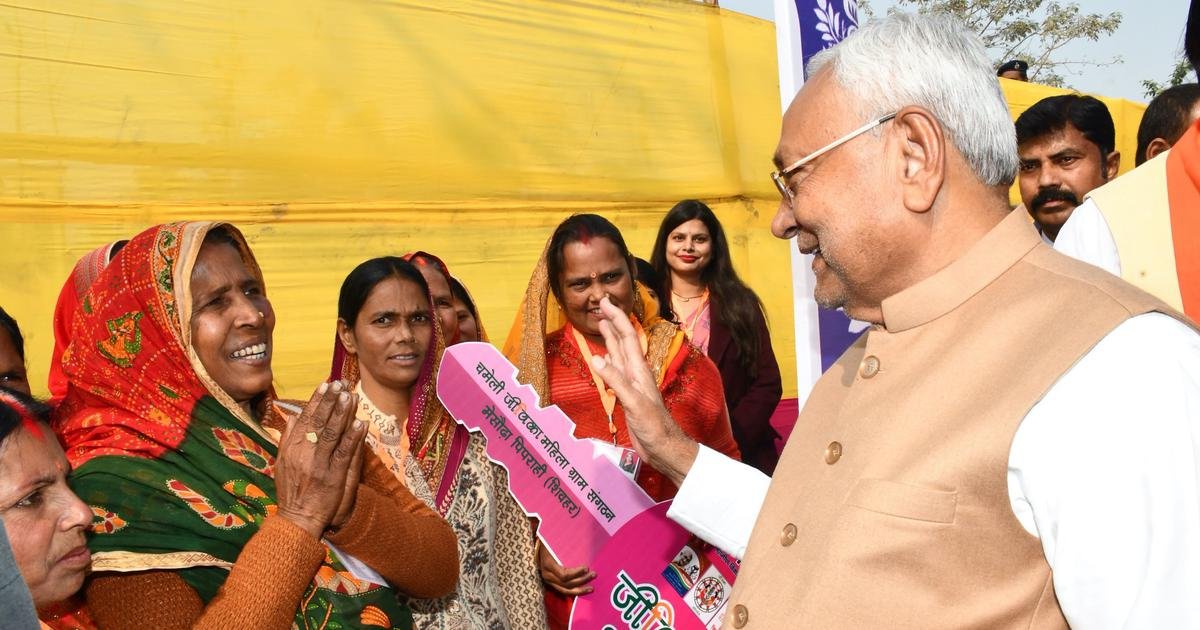
November 2, 2025: Just five days before the first phase of the Bihar Assembly elections on November 6, the Nitish Kumar government released the sixth instalment of ₹10,000 under its Mukhyamantri Nari Samman Yojana, a scheme aimed at providing direct cash assistance to women. The seventh instalment is scheduled for November 7 — barely four days ahead of the second phase of polling.
Each instalment, credited directly into women’s bank accounts, has triggered sharp controversy. With the Model Code of Conduct (MCC) already in place, opposition leaders have called the timing a brazen attempt at vote-buying, not welfare delivery. Critics argue that what is being portrayed as a “women empowerment initiative” is, in reality, cash-for-votes under the guise of policy continuity.
The Timing That Tells Its Own Story
The Nari Samman Yojana was announced hurriedly in early October — just a week before the Election Commission declared Bihar’s poll schedule. Within days of the MCC coming into effect, disbursements began. By now, three cash instalments have already been handed out — and two more are set to follow right before people queue up to vote.
Officials claim this is part of an “ongoing scheme,” but the facts suggest otherwise:
The scheme was launched barely a week before the election announcement.
It targets women voters, a crucial constituency for Chief Minister Nitish Kumar.
Payments are timed between poll phases, ensuring maximum political visibility.
If this is not electoral inducement, opposition parties ask, what is?
Formal Complaint to the Election Commission
The controversy deepened when RJD MP Prof. Manoj Kumar Jha lodged a formal complaint with the Election Commission on October 31, alleging a “brazen violation” of the Model Code of Conduct.
In his letter, addressed to Chief Election Commissioner Rajiv Kumar, Jha stated that the Bihar government had released ₹10,000 each to beneficiaries on October 17, 24, and 31, and was preparing another disbursement on November 7, just three days before the second phase of polling.
He termed the timing a “clear and deliberate breach” of the MCC, which came into effect on October 6, following the poll announcement. Jha’s letter accuses the government of attempting to influence voter behaviour through direct financial inducement, thereby vitiating the level playing field that the Election Commission is constitutionally mandated to uphold.
“The timing of this cash transfer, coming after the MCC has been enforced and just weeks before polling dates, demonstrates a calculated attempt to influence voter behaviour through direct financial benefit,” Jha wrote. “It undermines the purity of the electoral process and raises serious questions about fairness.”
Jha urged the Commission to take “immediate and strong action,” arguing that the disbursement of funds to beneficiaries at this stage was nothing less than vote-buying with public money.
मेरे बिहारी बहनों और भाईयों,
विषय: आपको ग़ुलाम बनाने का षड्यंत्र ❗️👇
🚨Election Commission of India has failed in its Constitutional Duty.
🚨The Opposition should bring in impeachment motion against CEC Gyanesh Kumar.
▪️The Model Code of Conduct for Bihar Elections came… pic.twitter.com/XJiKsLSbom
— Raju Parulekar (@rajuparulekar) November 1, 2025
Opposition Slams “Vote Kharidi” in Broad Daylight
RJD leader Tejashwi Yadav echoed Jha’s complaint, calling the payouts a “bribe for votes.”
“Money being given to women just before elections is not empowerment — it’s inducement,” Yadav told India Today. “If Nitish Kumar truly cared for women, he wouldn’t wait for election season to remember them.”
Journalist Rajdeep Sardesai also took aim at the Election Commission’s silence, writing on X:
“So, sixth instalment of ₹10,000 to 10 lakh women yesterday. Another on Nov 7, four days before polling. Model Code in place. EC ‘sources’ say it’s an ongoing scheme — which began a week before polls! Isn’t this vote kharidi?”
Election Commission’s ‘Ongoing Scheme’ Logic
The Election Commission has reportedly dismissed the complaints on the ground that the payments fall under an “ongoing program.” However, legal experts say this justification is flimsy.
Under MCC guidelines, existing welfare schemes may continue only if they predate the election announcement and follow a routine, pre-scheduled payment calendar. The Nari Samman Yojana, hurriedly launched in October and tailored to women voters, meets neither condition.
“It’s a textbook example of weaponising welfare,” said a retired Election Commissioner. “Once the MCC kicks in, any discretionary cash transfer by the ruling party — especially new or unscheduled — must be frozen.”
READ: Lawlessness’ Charge: Nitish Gets Mokama Don Anant Singh Arrested on Poll Eve
READ: Muivah Spew Venon against India, New Delhi Looks the Other Way
When Welfare Turns Into a Weapon
Nitish Kumar’s supporters defend the payouts as a legitimate welfare initiative. But economists and policy experts see political choreography, not governance.
“The scheme lacks institutional structure, budgetary clarity, or long-term vision,” said senior journalist Faizan Ahmad. “It’s cash politics masquerading as empowerment — timed to perfection for electoral impact. It’s nothing but vote-for-cash.”
Observers say the Chief Minister’s move reflects anxiety within the JD(U)-BJP alliance, facing a resurgent RJD and growing anti-incumbency. Women — long a core support base for Nitish Kumar — appear to be the primary target of this last-minute political outreach.
The Ethical Question: Democracy for Sale?
Beyond legalities, the controversy poses a larger ethical dilemma.
When a government transfers cash to citizens just days before they vote, can the election still be called free and fair?
The imagery is striking — women queuing at banks to withdraw ₹10,000 while campaign banners for the same government flutter nearby. Even if technically “legal,” the act undermines the spirit of electoral neutrality.
“Fair play isn’t about bending the law — it’s about upholding its intent,” said a senior Patna High Court lawyer. “Here, the intent seems clearly political.”
A Dangerous Precedent
Analysts warn that Bihar’s case could open floodgates nationwide. If unchallenged, ruling parties in other states may follow suit — timing welfare payouts with election cycles to buy goodwill and votes.
For voters, the short-term gain is real. But for democracy, it marks a gradual corrosion of trust.
As one RJD leader remarked, “This isn’t governance — it’s governance for rent, ₹10,000 at a time.”
The Question Bihar Must Ask
The final instalments on November 1 and November 7, strategically aligned with the first and second phases of voting, leave little to the imagination. Whether labelled as empowerment or welfare, the outcome is the same: cash in hand before the ballot.
In a state where poverty and politics intertwine, the episode raises a fundamental question:
When the ballot is bought with the budget, what remains of democracy?