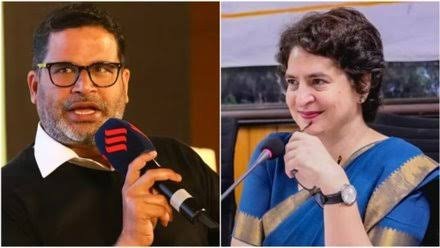
Kishor’s meeting with Priyanka Gandhi Vadra has fuelled speculation of a thaw in relations after their bitter 2022 fallout. While both sides have played down the interaction, its timing—soon after the Bihar debacle—makes it politically significant.
BY Navin Upadhyay
December 15, 2025: Ever since Prashant Kishor’s Jan Suraaj experiment ended in a humiliating rout in the Bihar Assembly elections, political observers have increasingly argued that the strategist-turned-politician may have reached an unavoidable conclusion: Indian elections are not won on good intentions, clean rhetoric, or “pure politics” alone. Organisation, alliances, money, and cadre matter—and without them, even the most sophisticated campaign collapses.
That reading has gained renewed traction after Kishor’s meeting with Congress leader Priyanka Gandhi Vadra, an interaction widely seen as the first visible sign of a thaw between Kishor and the Congress after their acrimonious split. While both sides have downplayed the significance of the meeting, its timing—coming close on the heels of the Bihar debacle—has made it politically loaded.
The Bihar elections, held in November 2025, were meant to be Jan Suraaj’s moment of arrival. Founded by Kishor with promises of clean governance, youth empowerment, and a decisive break from caste-driven politics, the party contested over 200 seats. The outcome was devastating: Jan Suraaj failed to win a single seat, lost deposits in the overwhelming majority of constituencies, and secured a vote share that barely scraped past single digits. The verdict was not merely a rejection of the party—it was a harsh reminder of the unforgiving nature of Bihar’s electoral terrain.
That terrain demands deep organisational roots, intricate caste arithmetic, alliance management, and street-level mobilisation. Jan Suraaj, despite Kishor’s high-voltage campaigning and data-heavy outreach, lacked all of these. Ironically, the Congress—fighting as part of the Mahagathbandhan—also emerged weakened, registering one of its poorest performances in the state. The result has forced both Kishor and the Congress to confront uncomfortable truths about their respective limitations.
The Case for Mutual Dependence
Political analysts increasingly see the possibility of renewed engagement between Kishor and the Congress as less an ideological convergence and more a matter of mutual survival.
For the Congress, still struggling to regain relevance in the Hindi heartland, Kishor represents something it desperately lacks: professional election management. His track record has cemented his reputation as one of India’s most effective political strategists. Beyond data and messaging, Kishor’s ability to engage with regional leaders across ideological lines could be valuable at a time when opposition unity remains fractured and initiatives like the INDIA bloc have failed to sustain momentum.
For Kishor, the Bihar verdict has exposed the structural weakness of his solo political venture. Jan Suraaj, launched after his much-publicised padyatra in 2022, positioned itself as a people’s movement outside the traditional ecosystem of dynasties and entrenched parties. But Bihar’s political reality—dominated by the RJD, JD(U), and BJP—left little space for a start-up party without legacy networks or loyal cadres. As many analysts note, Indian democracy rewards institutional depth far more than individual charisma. Even successful insurgent parties like the AAP or TMC took years, if not decades, to convert movements into durable political machines.
READ: Crores for a Messi Handshake, Pennies for Indian Athletes
READ: Chilling Videos Reveal Standoff and Heroism at Bondi Beach
Aligning with the Congress would allow Kishor to plug into a national organisation, access resources, and scale his reformist ideas beyond pilot experiments. For a man who has always argued that systemic change requires political power, the Congress offers a ready—if deeply flawed—platform.
BREAKING 🚨
Priyanka Gandhi gives an audience to Prashant Kishor 🔥🔥
“According to Congress sources, Jan Suraj founder Prashant Kishor recently met with Congress General Secretary Priyanka Gandhi.
The meeting between the two leaders has fueled speculation.” pic.twitter.com/4XbY7DQk1j
— Ravinder Kapur. (@RavinderKapur2) December 15, 2025
Old Wounds, New Calculations
Yet, any rapprochement is burdened by heavy political baggage. Kishor’s break with the Congress in 2022 was bitter and public. After presenting a sweeping revival plan to the Gandhi family—calling for decentralised leadership, performance-based promotion, and the sidelining of non-performing leaders—he walked away, accusing the party of lacking the will to reform itself. The Congress, in turn, offered him a place in an Empowered Action Group, which he declined, arguing that the party needed transformational leadership rather than external fixes.
Since then, Kishor has been openly critical of the Congress. Even during the Bihar campaign, he dismissed Rahul Gandhi’s focus on electoral roll revisions and “vote theft” as politically irrelevant in the state, positioning himself as more attuned to ground realities.
Post-election, however, Kishor’s tone appears to have softened. Insiders say the meeting with Priyanka Gandhi—held in Delhi amid wider speculation about opposition realignments—was exploratory rather than transactional. Discussions reportedly ranged from Bihar’s political vacuum to the broader challenge of opposition consolidation ahead of the 2029 Lok Sabha elections. Congress sources describe it as an informal brainstorming session, while Kishor has characterised it as a personal interaction, carefully avoiding any talk of alliances.
What It Means for Opposition Politics
If this tentative engagement matures into collaboration, it could signal a shift in how the opposition confronts the BJP’s dominance. Kishor’s data-driven, outcome-focused approach could inject much-needed professionalism into Congress campaigns, addressing chronic weaknesses such as booth-level management, voter targeting, and narrative coherence.
But resistance within the Congress is inevitable. Many senior leaders are likely to view Kishor as an outsider who threatens established hierarchies—precisely the fear that derailed his earlier reform proposals. For Kishor, partnering with the Congress risks diluting his carefully cultivated “anti-establishment” image. Yet, the alternative—persisting with Jan Suraaj through years of political marginality—appears far less attractive after Bihar.
As one Delhi-based analyst put it bluntly, the 2025 Bihar elections punctured the illusion of “pure politics.” In India’s electoral arena, ambition and intent mean little without organisation and alliances. Whether Prashant Kishor ultimately joins hands with the Congress or keeps the door strategically ajar, one lesson stands reinforced: in Indian politics, power is built collectively—or not at all.