Kuki-Zo relief committees say no channel was provided to submit memoranda detailing urgent security, housing and rehabilitation needs, deepening perceptions of institutional neglect
BY Navin Upadhyay
December 13, 2025: President Droupadi Murmu’s first visit to Manipur since the eruption of ethnic violence in May 2023 was meant to signal healing and reassurance. Instead, for the Kuki-Zo community, the two-day tour has come to embody what they describe as the State’s enduring bias—marked by selective outreach, exclusion, and a failure to acknowledge the epicentre of their suffering.
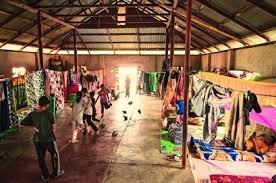
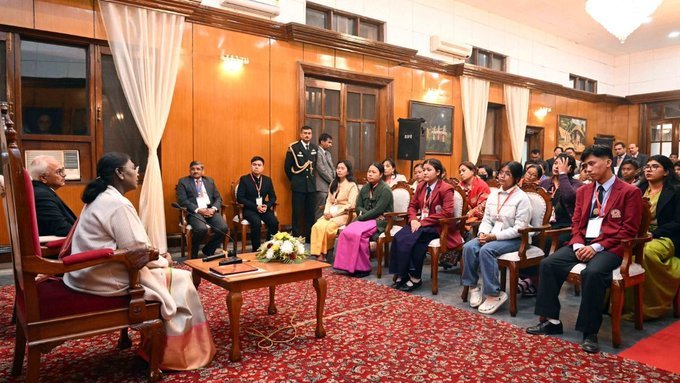
While the President met valley-based internally displaced persons (IDPs) in Imphal, inaugurated development projects, and reviewed rehabilitation efforts, thousands of displaced Kuki-Zo families in the hill district of Kangpokpi and adjoining areas were left out entirely. No meeting was scheduled, no relief camp visited, and no formal channel provided for Kuki-Zo representatives to submit their memorandum outlining urgent security and resettlement needs.
For a community that has borne the brunt of the violence—with villages razed, families uprooted, and over 50,000 people still living in relief camps—the omission was not seen as a logistical oversight but as a political statement.
A Missed Moral Moment
Many Kuki-Zo IDPs viewed the President’s visit as a rare chance to directly address what they consider the highest moral office of the Republic. Instead, they say, the State machinery ensured that the door remained firmly shut.
Leaders of the Kangpokpi District Internally Displaced Persons Welfare Committee (KDIDP/WC) say they prepared a detailed memorandum weeks in advance, documenting security gaps, housing losses, livelihood collapse, and fears surrounding forced camp closures. Yet, they allege, neither the district administration nor security agencies provided any route for the document to reach the President.
“We were told there was no protocol, no channel, no possibility,” said a committee member. “It felt as if our existence was inconvenient to the narrative.”
The sense of exclusion deepened when President Murmu visited Senapati district, which shares a border with Kangpokpi—the worst-hit district of the conflict. Despite geographical proximity, no interaction was arranged with Kuki-Zo IDPs, even symbolically.
Selective Outreach, Deepening Alienation
The contrast in the President’s engagements has sharpened perceptions of bias. Valley-based IDPs were met in Imphal, while hill-based Kuki-Zo camps—home to tens of thousands displaced since May 2023—were bypassed entirely.
Relief workers in Kangpokpi say the omission has left families confused and distressed. “Our camps are here, our suffering is here,” said a volunteer. “Yet the highest office in the land chose not to see us.”
Community leaders argue that such selective outreach reinforces an already deep valley–hill divide in Manipur, where political visibility and administrative attention have long been uneven.
READ: From Lungs to Heart: How Delhi’s Smog Harms the Human Body
Demands Left Unheard
The memorandum prepared by Kuki-Zo representatives outlines urgent demands, including enhanced security through new police outposts, realistic housing compensation reflecting the cost of rebuilding in hill terrain, protection of key transport routes, and fair compensation for those who lost homes and livelihoods in the Imphal valley.
The document also proposes a conditional roadmap for resettlement, stating that families are willing to return if security and basic support are guaranteed. Without these assurances, IDPs warn they face an indefinite future in relief camps.
None of these concerns, they say, reached the President.
Human Rights Groups Raise Alarm
The perceived exclusion has drawn sharp reactions from Kuki-Zo civil society and human rights organisations. The Kuki Organisation for Human Rights Trust (KOHUR) termed the visit an act of “symbolic violence,” arguing that avoiding Kangpokpi amounts to erasing the humanitarian epicentre of the conflict from national attention.
In a strongly worded statement, the group accused the State of prioritising political optics over survivor engagement and warned that plans to shut down relief camps without durable solutions would violate international norms on internal displacement.
Manipur: Kuki IDPs Say They Were Barred From Meeting Prez Murmu https://t.co/4ZuEMMPaCj #ManipurCrisis #KukiIDPs #PresidentMurmu #Kangpokpi #ConflictDisplacement #HillValleyDivide pic.twitter.com/WvNMxo3fC4
— POWER CORRIDORS (@power_corridors) December 12, 2025
Words Without Presence
At official events, President Murmu spoke of pain, resilience, and the government’s commitment to stand by every affected family. For Kuki-Zo survivors, however, the absence of physical presence rendered those words hollow.
With Manipur under President’s Rule, many expected the visit to break with past patterns and acknowledge all victims equally. Instead, critics say, the itinerary reflected caution and convenience—avoiding volatile regions and uncomfortable truths.
The disappointment is particularly acute because President Murmu herself hails from a tribal background. Many in the Kuki-Zo community had hoped this shared identity would translate into empathy and engagement.
A Visit That Spoke Through Silence
President Murmu’s Manipur visit has ultimately communicated as much through omission as through speech. By bypassing the worst-affected Kuki-Zo districts, the State has reinforced perceptions of unequal concern and selective compassion.
For a community still living in tents and trauma, the message was unmistakable: recognition remains elusive.
Until the voices from the hills are heard—and not merely acknowledged from a distance—Manipur’s wounds will remain open, and assurances of healing will continue to ring hollow.