Despite hundreds of letters sent to President Murmu since May 2023, Kuki-Zo calls for justice, rehabilitation, and on-ground recognition remain unanswered.
By Navin Upadhyay
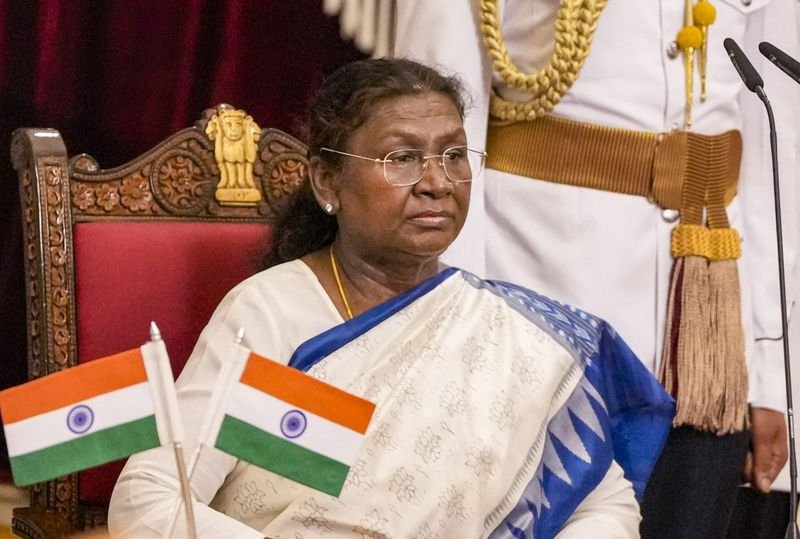
December 10, 2025: As dawn breaks over Manipur tomorrow, President Droupadi Murmu begins a two-day visit to the conflict-scarred state. For the Kuki-Zo community—still reeling from unprecedented ethnic violence, displacement, and state neglect—the visit carries fragile hope. In a statement issued today, the Kuki-Zo Council (KZC) welcomed the President warmly, invoking her tribal identity and describing her as a “beacon of solidarity” for a people devastated by 18 months of turmoil.
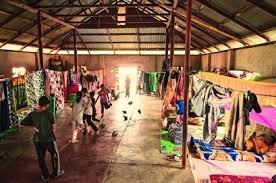
Yet beneath the cordial tone lies a growing ache: despite hundreds of unanswered letters, pleas, and petitions, the President’s itinerary once again avoids the Kuki-Zo heartlands. Her programme focuses on Meitei cultural landmarks in the valley and a brief stop in a Naga-majority district—leaving out the relief camps in Churachandpur, Kangpokpi, and Tengnoupal where tens of thousands of Kuki-Zo survivors remain marooned in uncertainty.
For a community that once viewed Murmu’s historic presidency as a bridge between India’s Adivasi leadership and Manipur’s tribal peripheries, the omission feels less like administrative oversight and more like an expanding gulf of empathy.
A Valley-Centric Itinerary
According to officials, Murmu will land in Imphal on December 11, beginning her schedule at the historic Imphal Polo Ground—an unmistakable nod to Meitei royal tradition.
The next day, December 12, she will preside over the 86th Nupi Lal Day commemorations at the Nupi Lal Memorial Complex, honouring Meitei women’s historic uprisings against colonial rule. It is a significant cultural moment, but one overshadowed by the tragedy of sexual violence inflicted on Kuki-Zo women during the clashes, including the 2023 parade incident that shocked the nation.
READ: Opinion: Kuki-Zo Demand for UT Faces Ground-Level Inaction
Following the memorial, Murmu will proceed to Senapati district for official engagements. The visit to a Naga-majority enclave adds a layer of symbolic inclusion—yet it inevitably raises a deeper question: How can the President address Manipur’s crisis without physically acknowledging the worst-hit communities?
Over 40,000 displaced Kuki-Zo still languish in makeshift camps, some since May 2023, with malnutrition, suicides, and trauma rising sharply. For them, the President’s absence is not logistical—it is deeply personal.
Officials privately admit the itinerary was designed around “low-risk, high-symbolism” events, especially after CorCom’s shutdown call for December 11–12. Security concerns, ceremonial obligations, and political sensitivities shaped the route.
But to the Kuki-Zo, it reinforces a painful message: ritual matters more than reality.
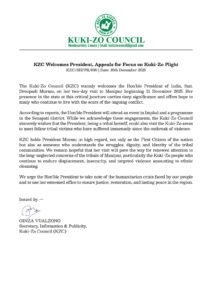
Hundreds of Letters, Little Response
Since the violence erupted in May 2023, Kuki-Zo civil society groups, churches, diaspora networks, and women’s organisations have submitted hundreds of letters to Rashtrapati Bhavan.
These detailed personal and collective horrors—arson, targeted killings, sexual violence, and allegations of state complicity.
Appeals came from:
- village chiefs and CSOs documenting displacement
- diaspora groups urging justice for sexual-violence survivors
- 10 Kuki-Zo MLAs seeking Union Territory status
- opposition leaders calling out administrative paralysis
Yet the responses have largely been procedural acknowledgements, without substantive engagement or visits to affected sites.
For a community whose suffering remains overshadowed by political narratives, this silence deepens the sense of abandonment.
The Empathy Deficit
Murmu’s rise to the presidency was hailed as a major milestone for India’s tribal communities. Many Kuki-Zo families prayed for her intervention, believing that her lived experience as a Santhal woman from an underprivileged region would translate into moral clarity and empathetic leadership during Manipur’s darkest hour.
Analysts agree that the President’s constitutional power is limited. Yet, as her visits to Odisha’s tribal belts demonstrated in 2024, symbolic gestures and direct engagement can influence public discourse, reassure communities, and create momentum for accountability.
Her absence from the Kuki-Zo hills—despite her identity as a tribal head of state—has therefore struck an emotional blow, feeding the growing perception that even shared indigeneity cannot pierce Delhi’s political calculus.
Echoes in the Hills: A Growing Sense of Betrayal
As Murmu’s helicopter returns to Delhi, the unvisited skies over Churachandpur, Kangpokpi, and Tengnoupal will tell their own story: not just of logistical gaps but of a broken symbolic covenant between India’s tribal communities and their highest constitutional representative.
For many Kuki-Zo, the omission may strengthen calls for political autonomy, deepen resentment toward the state administration, and confirm fears that Delhi’s leadership—regardless of identity—remains tethered to the valley’s dominant narrative.
Until the President or the central government directly acknowledges the suffering of the hills, peace in Manipur risks remaining elusive—and Murmu’s legacy, for the Kuki-Zo, a flickering lamp in an unending storm.