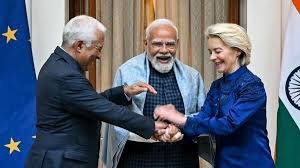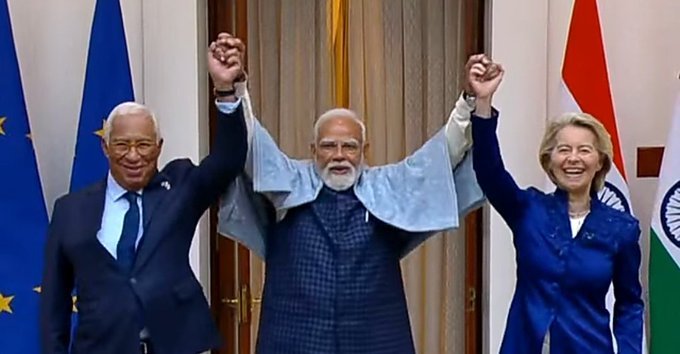
Beyond trade and tariffs, the deal strengthens India-EU strategic cooperation, with parallel agreements on security, defence, and supply-chain resilience aimed at countering global economic and geopolitical uncertainty.
BY PC Bureau
New Delhi, January 27, 29026: India and the European Union on Tuesday formally concluded their long-pending Free Trade Agreement, ending an 18-year negotiation process at the 16th India-EU Summit held at Hyderabad House. Prime Minister Narendra Modi, hosting European Commission President Ursula von der Leyen and European Council President António Costa, described the pact as a “perfect example of partnership” between two major global economies.
The agreement will eliminate tariffs on nearly 97 per cent of goods traded between the two sides, significantly boosting Indian manufacturing sectors such as textiles, gems and jewellery, and leather, while opening India’s market to European automobiles, machinery and high-end industrial goods. Leaders said the deal would create a combined market of nearly two billion consumers.
Beyond trade, the summit underscored a deepening strategic partnership. India and the EU signed a Security and Defence Strategic Partnership, reaffirming their commitment to a rules-based international order. The agreement follows growing defence cooperation, including the participation of EU naval personnel in India’s Republic Day parade, and focuses on maritime security, counter-terrorism and defence-industrial collaboration. Defence Minister Rajnath Singh and India’s three service chiefs participated in the discussions, highlighting the scope for Indian companies to access European defence programmes.
The “Mother of All Deals” is Here! 🇮🇳🇪🇺
The India-EU Free Trade Agreement (FTA) is finally sealed. This isn’t just a handshake; it’s a tectonic shift for the Indian economy.
Here is the data-backed breakdown of why this is a massive win for India and YOU. 🧵👇
1. The Big… pic.twitter.com/I4sDGHgVZo— Praveen Kumar (@RigidDemocracy) January 25, 2026
At the delegation-level talks, leaders reviewed the final text of what von der Leyen has called the “mother of all trade deals” and adopted a new roadmap for bilateral relations. Singh, following talks with EU High Representative Kaja Kallas, said both sides explored integrating defence supply chains to build trusted ecosystems and future-ready military capabilities.
Detailed provisions of the agreement point to sweeping tariff reductions across key sectors. India will gradually cut tariffs on European passenger vehicles to 10 per cent from current levels that can reach nearly 70 per cent, with an annual quota of 2,50,000 vehicles during the transition period. Tariffs on over 90 per cent of EU goods entering India will be eliminated or reduced, including machinery, chemicals, pharmaceuticals, aircraft and medical equipment.
PM Narendra Modi announces India–EU FTA talks concluded
-Deal covers 25% of global GDP & one-third of world trade
-Manufacturing, services to get major boost
-Strong signal for investors & businesses to invest in Indiapic.twitter.com/YDvy3joWoF— India First Post (@ifpost47) January 27, 2026
Food and beverage imports will also see significant changes, with tariffs on European wines cut to 20–30 per cent, spirits to 40 per cent and beer to 50 per cent. Duties on olive oil, vegetable oils and margarine will be reduced or eliminated. In services, the EU has secured expanded access in financial and maritime sectors—an area traditionally sensitive for India.
The EU estimates the deal could double its exports to India by 2032 and save European exporters up to €4 billion annually in duties. Brussels has also committed €500 million over the next two years to support India’s climate transition and green investments.
READ: US Slams EU-India Trade Pact, Flags Russian Oil Purchases
While the agreement strengthens Europe’s foothold in one of the world’s fastest-growing consumer markets, attention in India now turns to how domestic industries—particularly autos, machinery, chemicals and medical devices—will adapt to heightened European competition.
INDIA–EU FREE TRADE AGREEMENT: TARIFF SNAPSHOT
🚗 Automobiles
-
Tariffs cut to 10% from ~70%
-
Annual quota: 2,50,000 vehicles
-
Phased reduction over transition period
⚙️ Machinery
-
Current tariffs up to 44%
-
Largely eliminated under the deal
🧪 Chemicals
-
Existing duties up to 22%
-
Near-total tariff removal across product lines
💊 Pharmaceuticals
-
Tariffs around 11%
-
Most duties eliminated
🛫 Aircraft & Spacecraft
-
Near-blanket tariff removal
🩺 Medical, Optical & Surgical Equipment
-
Tariffs removed on 90% of products
-
Expected to reduce healthcare costs in India
🍷 Food & Beverages
-
Wine: 20–30%
-
Spirits: 40%
-
Beer: 50%
-
Olive oil, margarine & vegetable oils: Cut or eliminated
📊 Overall Impact
-
Tariffs reduced or removed on 90%+ of EU goods
-
EU expects exports to India to double by 2032
-
Estimated annual savings: €4 billion