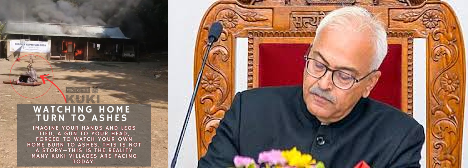
Despite eyewitness accounts, video evidence, and open claims of responsibility, Manipur Governor A.K. Bhalla has issued no condemnation, nor has the state administration acted against the perpetrators, fuelling perceptions of selective enforcement.
Navin Upadhyay
January 27, 2026: In the shadow of India’s 77th Republic Day celebrations on January 26, 2026, a grim tableau unfolded in Manipur’s Kangpokpi district. Armed cadres of the Kamsong faction of Zeliangrong United Front (ZUF-K), descended upon K. Songlung village—a predominantly Kuki-Zo settlement—at around noon.
Eyewitness accounts describe a harrowing scene: villagers were reportedly blindfolded, handcuffed, and terrorized with gunfire before their homes, farms, and livelihoods were set ablaze. The ZUF claimed the attack was an “enforcement action” against alleged poppy cultivation and land encroachment, but Kuki-Zo groups and local residents vehemently dispute this, asserting that the village sustained itself through legitimate orange farming and other agricultural pursuits.
This incident, occurring under President’s Rule in Manipur, has reignited debates over governance failures in the state. Yet, amid the outcry from civil society organizations (CSOs), armed groups, and affected communities, one voice remains conspicuously absent: that of Manipur’s Governor, Ajay Kumar Bhalla.
Governor Bhalla, a retired IAS officer appointed in January 2025, serves as the de facto head of the state administration under President’s Rule, imposed amid escalating ethnic tensions between Meitei and Kuki-Zo communities. His role is pivotal—not merely ceremonial but as the central government’s representative tasked with maintaining law and order, especially in a region plagued by insurgent activities and inter-community violence since May 2023.
The burning of K. Songlung is not an isolated event; it fits into a pattern of over 7,000 Kuki-Zo homes destroyed and more than 150 lives lost in the ongoing conflict, as highlighted in a press release by the Kuki-Zo Council (KZC). The silence from Raj Bhavan, the governor’s official residence, is not just an oversight but a potential catalyst for further instability, abetting narratives of bias and complicity.
“That a Kuki-Zo village could be reduced to ashes under President’s Rule is a clear demonstration of the Government’s inability to ensure law and order and the safety ofcitizens. It further proves that claims of “normalcy” in Manipur are far from reality. The Kuki-Zo people remain under constant threat,” KZC said in a press release.
It went on to demand immediate deployment of security forces to protect Kuki-Zo lives and property, adequate compensation for the affected families.
KZC_Press Release_27January2026
A Proxy War in the Hills
To understand the governor’s silence, one must first grasp the layered dynamics of the attack. The ZUF (Kamson faction), a Naga insurgent group, has been accused by Kuki-Zo armed outfits under Suspension of Operations (SoO) agreements with the Centre—such as the United People’s Front (UPF) and Kuki National Organisation (KNO)—of acting as a proxy for “actors in Imphal,” a veiled reference to Meitei interests in the valley.
These groups label ZUF (K) as a “rogue organisation” with “unholy linkages” to elements pursuing vested interests at the expense of hill tribes. Another Kuki-Zo armed groups, United Kuki National Army (UKNA), has alleged ties between ZUF (K) and the NSCN-IM, another Naga faction, framing the arson as part of a broader strategy of territorial coercion disguised as anti-narcotics efforts.
This is nothing short of disgraceful conduct by political sycophants like ZUF–Kamson Liangmei. We endured unimaginable suffering in the 1990s—do not provoke us by dragging back memories we have struggled for decades to bury. Make no mistake: the Kukis of today are not the Kukis… pic.twitter.com/zq80Pm6VIx
— IDPs Welfare Committee, Churachandpur (@idpwcc) January 26, 2026
Social media posts and eyewitness videos circulating on platforms like X (formerly Twitter) paint a vivid picture of the assault. One account from the village chief’s wife describes cadres blindfolding and tying villagers while raining bullets around them, only sparing lives after prayers and pleas.
Such tactics echo historical patterns of ethnic intimidation in Manipur, where land disputes and resource control often masquerade as moral crusades against poppy farming—a crop linked to narcotics but also a survival economy in remote hills. Critics, including the Committee on Tribal Unity (COTU), argue that these “campaigns” are tools for demographic engineering, aimed at displacing Kuki-Zo populations.
Notably, Kuki-Zo activists allege a deliberate design to sever connectivity between Kangpokpi and Churachandpur districts, forcing communities to rely on the Imphal highway. This, they claim, would project an image of “restored normalcy” beneficial to both Meitei interests and the state administration.
Whether factual or not, such narratives gain traction in the vacuum left by official inaction. The ZUF(K)’s open claim of responsibility, without immediate arrests or security deployments, underscores a perceived breakdown in governance.
READ: ‘ZUF (K) Will Reap What It Sows’: Kuki-Zo SoO Groups Warn After Arson, Allege Imphal Link
READ: Is a Proxy War Brewing in Manipur Hills Amid Official Silence?
The Governor’s Role and the Cost of Silence
Under Article 356 of the Indian Constitution, President’s Rule places the governor at the helm of executive authority, advised by the Centre. Bhalla’s administration is responsible for deploying security forces, initiating inquiries, and ensuring justice.
Yet, as of January 27, 2026, no formal statement has emerged from the governor’s office regarding the K. Songlung incident. COTU’s 24-hour ultimatum to the government—demanding arrests or facing shutdowns and blockades—directly criticizes the governor’s “constitutional authority” for failing to contain such elements, deeming it a demeaning lapse.
Why the Silence?
Several analytical lenses offer insights:
- Political Caution and Central Directives: Manipur’s ethnic fault lines make any statement a potential flashpoint. The Centre, through the governor, may be avoiding escalation by not publicly condemning ZUF, especially if it risks alienating Naga groups amid ongoing peace talks with NSCN-IM. Silence could be a strategic pause, allowing backchannel negotiations to prevent retaliatory cycles. However, this risks being interpreted as favoritism toward valley-based interests, eroding trust among hill tribes.
- Administrative Inertia and Resource Constraints: President’s Rule has not quelled violence; instead, it highlights the Centre’s challenges in managing a multi-insurgent landscape. With security forces stretched thin across contested districts, the governor’s office might prioritize containment over commentary. But this inertia fuels perceptions of selective enforcement—Kuki-Zo villages targeted without reprisal, while Meitei areas receive swifter protection.
- Abetting Divisive Narratives: As noted by the KZC, UPF, and KNO, the administration’s silence reinforces accusations of complicity. By not swiftly condemning the attack or providing compensation, it lends credence to claims that ZUF acts with impunity, possibly at the behest of Imphal-based “actors.” This narrative aligns with broader Kuki-Zo demands for a separate Union Territory, viewing the incident as evidence of unsafety under the current setup.
- Symbolic Implications on Republic Day: The timing—coinciding with national festivities—amplifies the irony. While India celebrated constitutional values, a village burned in defiance of them. The governor’s silence on such a symbolic day undermines the Republic’s promise of equality and security, particularly for marginalized tribal communities.
Erosion of Trust and Escalation
The governor’s reticence has tangible consequences. It emboldens armed actors, lowers the threshold for escalation, and deepens ethnic divides. Analysts warn of revived inter-insurgent rivalries overlaying the Kuki-Zo–Meitei conflict, turning civilian spaces into proxy battlegrounds.
For K. Songlung’s residents, the loss extends beyond homes to dignity and faith in the state. Without intervention, threats of blockades by COTU could disrupt supply lines, affecting the entire region.
Moreover, this silence contrasts with the vocal condemnations from Kuki-Zo bodies, who appeal for divine justice while demanding legal accountability. It highlights a governance paradox: President’s Rule was meant to restore order, yet incidents like this expose its limitations.
For lasting peace, the governor must break the silence—deploy forces, ensure arrests, and address root causes like land rights and narcotics without bias.
In conclusion, Governor Bhalla’s inaction on the K. Songlung arson is more than baffling; it’s a missed opportunity to reaffirm constitutional safeguards in a fractured state. Whatever the reasons—pragmatic or political—the cost is borne by vulnerable communities, pushing Manipur further from reconciliation.
The KZC urges, only robust political solutions, like a separate administration for Kuki-Zo areas, may stem this tide. “This incident once again stands as living proof that the Kuki-Zo people are no longer safe in Manipur and urgently require robust political and constitutional safeguards to protect their lives, land, and dignity,” KZC press release said.
Until theat happens, , silence speaks volumes, and in Manipur’s hills, it echoes with the crackle of flames.