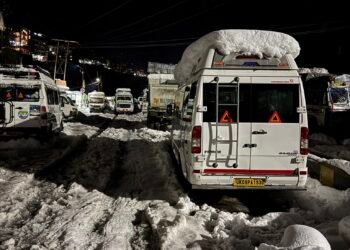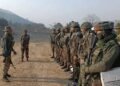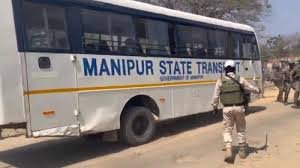
State-run buses are set to begin operating again from Khuman Lampak ISBT on January 22, reconnecting the Imphal valley with select hill and valley areas, while conflict-hit Kuki-Zo districts continue to remain without direct services.
BY PC Bureau
January 22, 2026 —In a move aimed at restoring public connectivity and ensuring “free movement” across parts of the state, the Manipur government’s Transport Department on Thursday officially recommenced inter-district and inter-state bus operations from the Inter-State Bus Terminus (ISBT) at Khuman Lampak, Imphal.
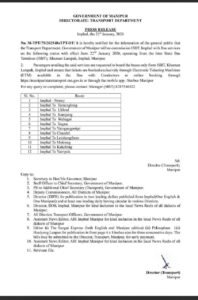
The services, effective January 22, cover 12 routes, primarily linking the Imphal valley with select hill districts and valley areas.
According to an official press release issued on January 21, buses will operate daily to Noney, Tamenglong, Ukhrul, Kamjong, Wabagai, Sugnu, Yaingangpokpi, Chandel, Leishangthem, Moirang, Kakching, and Yairipok.
All passengers are required to board exclusively from the ISBT. Tickets can be purchased through Electronic Ticketing Machines (ETM) on board, the Manipur State Transport mobile application, or via the official portals: manipurstatetransport.mn.gov.in and starbus.manipur.gov.in.
The resumption is part of broader efforts to revive public transport infrastructure that has remained disrupted since ethnic violence between Meitei and Kuki-Zo communities erupted in May 2023. Earlier announcements in January 2026 had indicated plans to make the ISBT fully operational to ease urban congestion and improve mobility.
However, the list of destinations notably excludes direct bus services to the Kuki-Zo majority districts of Churachandpur and Kangpokpi, located south and north of the Imphal valley, respectively. Both districts have remained flashpoints of the ethnic conflict, and repeated attempts in the past to resume state-run bus services to these areas have failed.
Previous initiatives—in late 2023, December 2024, and March 2025—to operate buses to Churachandpur (via Bishnupur) and Kangpokpi/Senapati were frequently disrupted by road blockades, protests, low passenger turnout, and security concerns, despite escorts provided by central forces. In several instances, services ran symbolically with few or no passengers. Tribal bodies such as the Committee on Tribal Unity (CoTU), Indigenous Tribal Leaders’ Forum (ITLF), and the Kuki-Zo Council had opposed the services, citing safety concerns and reiterating demands for a separate administrative arrangement.
READ: Chilling Footage Shows Execution-Style Killing of Meitei Man in Manipur
The continued exclusion of these districts has renewed debate over the reality of movement restrictions in Manipur. While the state government and Governor Ajay Kumar Bhalla have consistently denied the existence of formal “buffer zones,” describing restrictions as temporary security measures, critics argue that de facto ethnic divisions persist. These include guarded foothill stretches, restricted access to mixed-population areas, and limited civilian movement along certain inter-district corridors.
Kuki-Zo organizations maintain that coexistence under the current framework remains difficult in the aftermath of the violence, pointing to large-scale displacement, extortion along highways, and unresolved jurisdictional issues. Valley-based groups, meanwhile, stress the need to uphold Manipur’s territorial integrity and the constitutional guarantee of free movement.
For queries or complaints, passengers may contact the Manager, Manipur State Transport, at 8787546522.
While the resumption of bus services marks a tentative step toward normalcy along select corridors, the continued absence of routes to Churachandpur and Kangpokpi underscores the persistent ethnic fault lines and security challenges that continue to fragment connectivity in the state nearly three years after the conflict began.