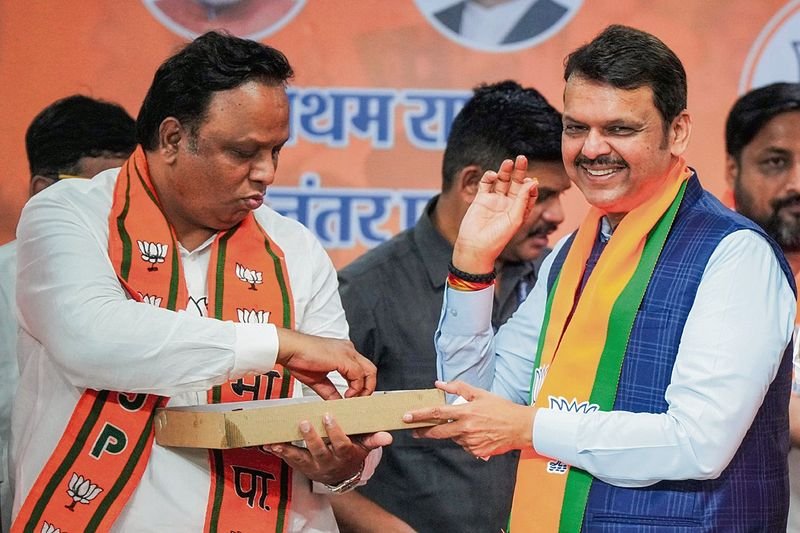
Combining grassroots mobilisation with disciplined campaign management, Ashish Shelar emerged as the principal architect behind the BJP’s strong performance in the BMC elections.
BY PC Bureau
January 18, 2026: While Chief Minister Devendra Fadnavis remained the unmistakable face of the BJP’s campaign for the Maharashtra civic polls, it was senior minister and BJP’s BMC poll in-charge Ashish Shelar who quietly but decisively reinforced the effort on the ground. Drawing on his deep organisational experience as former Mumbai BJP chief, Shelar played a pivotal role in dismantling the decades-long dominance of the Thackerays in the Brihanmumbai Municipal Corporation.
Together, Fadnavis and Shelar emerged as a textbook example of political synergy—where vision and mass appeal were matched by meticulous planning and silent execution. Their partnership reflected the balance essential for major political breakthroughs: leadership that inspires from the front and organisational skill that delivers results behind the scenes. This blend of strategy and execution proved crucial in scripting one of the BJP’s most consequential civic victories in Maharashtra.
In the turbulent and fiercely competitive arena of Mumbai politics, few leaders have demonstrated the combination of organisational discipline, electoral foresight, and political stamina that Ashish Shelar has displayed over the past decade. The BJP’s performance in the Brihanmumbai Municipal Corporation (BMC) elections was not an accident of circumstance, nor merely the result of favourable political winds. It was the culmination of years of structured party-building and strategic planning—much of it bearing the unmistakable imprint of Ashish Shelar.
As the BJP’s in-charge for the Mumbai civic polls, Shelar functioned as the principal architect of the party’s campaign. He approached the BMC contest with the understanding that Mumbai is not just another municipal body, but the political, economic, and symbolic heart of urban India. Winning here required more than slogans—it demanded organisational depth, credibility on governance, and an ability to connect with a city that is socially diverse, politically alert, and often sceptical of grand promises.
Shelar’s strategy rested on three pillars: strengthening the grassroots organisation, sharpening the party’s governance narrative, and maintaining ironclad internal coordination. Booth-level committees were activated well in advance, data-driven assessments of wards guided candidate selection, and local issues—ranging from infrastructure and housing to transparency in civic administration—were brought to the centre of the campaign. The result was a BJP campaign that appeared disciplined, focused, and prepared, even as rival formations struggled with internal contradictions.
Crucially, Shelar’s effectiveness during the civic polls cannot be separated from his tenure as Mumbai BJP president until August last year. That period was marked by sustained organisational consolidation. Under his leadership, the Mumbai BJP moved away from personality-centric politics and invested heavily in cadre development, internal training, and structured communication. The party expanded its presence in areas where it had traditionally been weak, while simultaneously consolidating its base in strongholds through continuous engagement with voters.
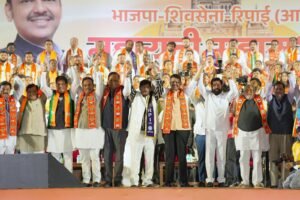
One of Shelar’s most enduring contributions was his emphasis on leadership development. He actively promoted second-line leaders, encouraged corporators to function as year-round representatives rather than election-time figures, and ensured that the party machinery remained active between electoral cycles. This approach helped the BJP project itself as a serious governing alternative rather than a reactive opposition.
READ: From Mumbai to Pune, Saffron Surge Redraws Civic Power Map of Maharashtra
At a time when Mumbai’s political environment was marked by fragmentation, shifting alliances, and ideological ambiguity, Shelar ensured clarity of purpose within the BJP. He fostered coordination between the state leadership, local representatives, and the central command, minimising internal friction and presenting a united front to the electorate. His ability to manage complex political equations without allowing them to dilute the party’s core message set him apart as a strategist rather than a mere tactician.
मुंबई महानगरपालिका सार्वत्रिक निवडणूक २०२६ चे निकाल जाहीर झाले. भाजपाचे तीन सिटिंग नगरसेवक पुन्हा जिंकून आले तर नव्याने संधी मिळालेल्या तीन कार्यकर्त्यांचा निसटता पराभव झाला असला तरी त्यांना चांगली मते मिळाली. या सगळ्यात भाजपाचे पदाधिकारी, कार्यकर्ते यांनी खूप परिश्रम घेतले. आज… pic.twitter.com/DSjcvs1eDg
— Adv. Ashish Shelar – ॲड. आशिष शेलार (@ShelarAshish) January 16, 2026
Equally noteworthy was his calm handling of political pressure. Mumbai’s civic politics is unforgiving, with constant media scrutiny and relentless opposition attacks. Shelar responded not with rhetoric alone, but with methodical counter-strategies—ground reports, issue-based responses, and disciplined communication. This steadiness helped the party maintain momentum even during challenging phases of the campaign.
Observers across party lines acknowledge that Ashish Shelar combines ideological commitment with pragmatic governance politics. He understands that urban voters demand performance, not symbolism. By framing the BJP’s civic agenda around accountability, infrastructure delivery, and administrative efficiency, he aligned the party’s message with the everyday concerns of Mumbai’s residents.

The BMC outcome ultimately reflected this long-term vision. While electoral numbers tell one part of the story, the deeper significance lies in how the BJP has emerged as a structurally stronger, more confident political force in Mumbai. That transformation owes much to Shelar’s years of patient organisational work and his strategic leadership during the civic contest.
Ashish Shelar’s journey in Mumbai BJP illustrates a fundamental truth of politics: enduring success is built not merely through charismatic moments, but through sustained institutional strengthening. As the party looks ahead to future electoral battles in Maharashtra’s urban centres, the Mumbai model shaped under Shelar’s leadership is likely to serve as a reference point.
Early Life and RSS Roots
Shelar’s political instincts took shape early. During his school days in Mumbai, he became associated with the Rashtriya Swayamsevak Sangh (RSS) — the right-wing volunteer organisation that serves as the ideological parent of the BJP. He completed the RSS Prathamik Varga course, which is an introductory training programme for young volunteers.
His active engagement continued into college, where he joined the Akhil Bharatiya Vidyarthi Parishad (ABVP), the RSS-linked student organisation. There, he quickly emerged as a leader, eventually serving as Mumbai Secretary of ABVP, a significant role in the city’s student politics that paved the way for his transition into mainstream BJP politics.
Shelar’s longstanding association with the RSS has been a defining feature of his political identity. The RSS — a volunteer organisation committed to promoting Hindu cultural nationalism — often functions as the ideological fountainhead for BJP leaders across the country. Shelar’s early grounding in RSS values and his leadership within ABVP provided him with organisational training, network access, and ideological clarity that have informed his political career throughout.
This link has shaped both his approach to party building and his stance on policy issues, ensuring that his political path is consistent with the broader cultural and organisational ethos of the Sangh Parivar.
In Mumbai’s complex political history, Ashish Shelar will be remembered not just as an election in-charge or party president, but as a builder of political capital—one who understood the city’s pulse and helped reshape the BJP’s trajectory in India’s financial capital.