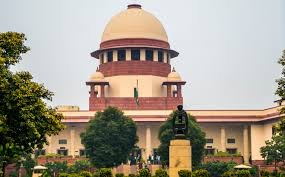
The ED alleged in the Supreme Court that Chief Minister Mamata Banerjee and senior state police officials obstructed its search at I-PAC, calling it a pattern of interference that undermines central agency probes.
BY PC Bureau
New Delhi, January 15: The Supreme Court on Thursday flagged serious concerns over alleged interference by West Bengal authorities in the Enforcement Directorate’s (ED) investigation into political consultancy firm I-PAC, observing that the issue raises larger questions about the rule of law, institutional independence, and the functioning of central investigative agencies.
After hearing detailed submissions from both sides, a bench of Justice Prashant Mishra and Justice Vipul Pancholi said the pleas before it involve grave allegations of obstruction of a lawful investigation and therefore warrant close scrutiny. The court noted that allowing such issues to remain unresolved could aggravate the situation and potentially lead to “lawlessness” in one or more states.
“The matter raises serious concerns about investigations by central agencies and alleged interference by state authorities. To uphold the rule of law, it must be ensured that no offender is shielded under the protection of any state,” the bench observed while issuing notice in the case and directing the respondents to file their counter affidavits within three days.
#BREAKING: Supreme Court issues notice to Mamata, Bengal Government, West Bengal Police. Interference by State Govt agencies on ED or Central Govt agencies is a serious matter. Incident CCTV to be preserved. Supreme Court stays FIR against ED officers. Next hearing on Feb 3
— Amit Singh 🇮🇳❣️ (@KR_AMIT007) January 15, 2026
ED Alleges Obstruction, ‘Mobocracy’
Appearing for the ED, Solicitor General Tushar Mehta told the court that the agency was conducting a lawful search under the Prevention of Money Laundering Act (PMLA) at I-PAC premises when senior West Bengal police officials, followed by Chief Minister Mamata Banerjee, entered the site despite repeated requests not to interfere.
The ED alleged that materials collected during the search were unlawfully taken away and that FIRs were subsequently registered against ED officers by the state police. The agency further submitted that when the matter came up before the Calcutta High Court, a large group of lawyers unrelated to the case disrupted proceedings, forcing the judge to adjourn the hearing.
Describing the incident as “mobocracy,” Mehta argued that such conduct undermines judicial processes and sets a dangerous precedent. He alleged that WhatsApp messages circulated by the Trinamool Congress’s legal cell mobilised lawyers to assemble in court, creating chaos.
The ED also cited earlier instances involving central agencies to argue that the I-PAC episode reflected a pattern of interference, making it difficult to conduct impartial investigations into alleged large-scale scams in the state.
Mamata Banerjee’s Defence
Senior advocate Kapil Sibal, appearing for Mamata Banerjee and the Trinamool Congress (TMC), rejected the allegations and argued that the ED’s petitions were not maintainable, particularly as related proceedings were already pending before the Calcutta High Court.
Sibal told the court that nothing at the I-PAC premises was relevant to the ED’s probe except confidential election-related material, over which the central agency had no authority. He argued that Banerjee had entered the premises not in her capacity as Chief Minister, but as chairperson of the Trinamool Congress, after receiving information that party-related materials were being removed.
“The ED knew that the I-PAC office housed sensitive election data under a formal contract with the TMC. Conducting a raid there, just ahead of elections, was a malafide act,” Sibal submitted.
He further stated that Banerjee is a Z-category protectee, making it mandatory for senior police officers, including the Director General of Police, to accompany her during such visits.
Court Unmoved by ‘Election Work’ Argument
The Supreme Court, however, cautioned that party work or election-related activity cannot be used as a shield to obstruct a bona fide criminal investigation. While noting that no agency has the right to interfere in legitimate election processes, the bench made it clear that when a central agency is acting in good faith to investigate a serious offence, its powers cannot be curtailed under the guise of political activity.
Based on the panchnama placed on record, the court noted that no substantial recovery was made during the January 8 search. However, it observed that the core issue was not recovery, but alleged obstruction and intimidation of investigating officers.
READ: Most Kuki-Zo MLAs Shut Door on Manipur Govt Sans UT Committment
Parallel Proceedings and FIRs
Senior advocate Abhishek Manu Singhvi, representing the West Bengal government and state police, accused the ED of “forum shopping,” arguing that the agency had approached both the Calcutta High Court and the Supreme Court seeking identical reliefs.
The bench responded that circumstances in such matters can evolve rapidly, and stressed that repeated disruptions or interference cannot be justified on grounds of procedural overlap or emotional responses.
The ED has sought protection for its officers under Article 21, a stay on FIRs registered against them, and consideration of transferring the investigation outside West Bengal. The agency also pointed to intelligence inputs indicating a ₹20 crore fund transfer linked to a larger probe dating back to 2020.
Observing that senior state officials, including the police leadership, are named in the allegations, the Supreme Court said it would examine the matter itself “in the larger interest of justice” and, for now, restrained further proceedings before the Calcutta High Court.
The case is likely to have far-reaching implications on Centre–state relations, the autonomy of investigative agencies, and the limits of political intervention in criminal probes, particularly during election seasons.