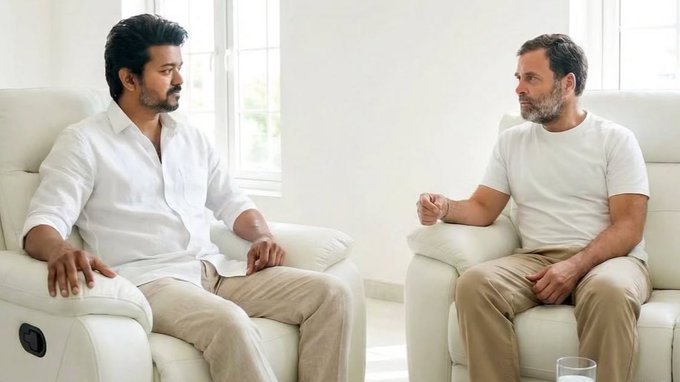
Targeting PM Modi, Rahul Gandhi said the Information and Broadcasting Ministry’s actions against Jana Nayagan reflected a larger effort to silence the voice of the Tamil people.
BY PC Bureau
New Delhi, January 13, 2026 — Leader of the Opposition Rahul Gandhi on Tuesday accused the Centre of attacking Tamil culture by allegedly attempting to block the release of actor-politician Vijay’s film Jana Nayagan, triggering a sharp political exchange between the Congress and the BJP.
Targeting Prime Minister Narendra Modi, Gandhi said the Information and Broadcasting Ministry’s actions amounted to cultural suppression. “The I&B Ministry’s attempt to block Jana Nayagan is an attack on Tamil culture. Mr Modi, you will never succeed in suppressing the voice of the Tamil people,” he said in a post on X.
The BJP hit back strongly, calling Gandhi a “habitual liar” and accusing the Congress of hypocrisy. BJP spokesperson C.R. Kesavan said it was the Congress-led UPA government that had previously “insulted Tamil culture,” citing its opposition to Jallikattu, a traditional sport closely linked to the Pongal festival.
“Thanks to Prime Minister Narendra Modi’s sustained efforts, the ban on Jallikattu was lifted. Rahul Gandhi’s remarks on a matter that is now sub judice reveal his dubious intent and expose the Congress party’s authoritarian mindset,” Kesavan said, invoking instances of censorship during the Emergency.
The I&B Ministry’s attempt to block ‘Jana Nayagan’ is an attack on Tamil culture.
Mr Modi, you will never succeed in suppressing the voice of the Tamil people.
— Rahul Gandhi (@RahulGandhi) January 13, 2026
READ: Army Was Ready for Ground Foray During Op Sindoor, Says Army Chief
READ: From Code to Call Centres: AI’s Quiet Takeover of Indian Jobs
Kesavan also referred to past film bans, including Aandhi, Kissa Kursi Ka, and the Tamil film Kutrapathrikkai, which was completed in 1992 but released only in 2007, alleging systematic suppression under Congress regimes. He further accused the Congress-DMK alliance of political opportunism, predicting its rejection by Tamil Nadu voters.
The controversy centres on Jana Nayagan, Vijay’s much-publicised final film before his full-time entry into politics through his newly launched party, Tamilaga Vettri Kazhagam (TVK). The film was originally scheduled for release on January 9.
The movie was submitted to the Central Board of Film Certification (CBFC) on December 18. The examining committee flagged several issues and suggested 27 cuts, which the filmmakers reportedly complied with. On December 22, the committee recommended a U/A certificate, but the certificate was not issued, delaying the release.
On January 5, following a complaint, the CBFC referred the film to a revising committee. The filmmakers then approached the Madras High Court, which on January 9 directed the CBFC to issue the U/A certificate. However, the CBFC appealed the order, and a division bench stayed the single-judge ruling. The matter is now before the Supreme Court.
Earlier, the DMK had also accused the Centre and the BJP of deliberately delaying the film’s release. DMK leader T.K.S. Elangovan said the censoring process, which usually concludes within days, was being prolonged, forcing the filmmakers to seek judicial intervention.
The case has since evolved into a wider political flashpoint in Tamil Nadu, intersecting issues of censorship, cultural identity, and Vijay’s growing political presence ahead of the state’s electoral battles.