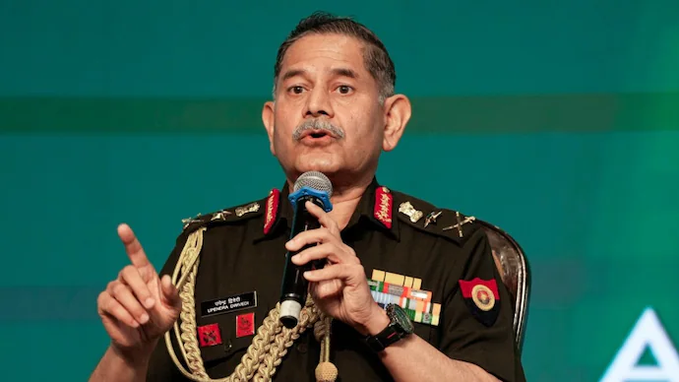
The Army chief described the Op Sindoor as a model of tri-service coordination, executed with clear political direction and full operational freedom.
By PC Bureau
New Delhi, January 13, 2026 — Chief of Army Staff General Upendra Dwivedi on Tuesday said the Indian Army was fully prepared to launch ground operations during Operation Sindoor, warning Pakistan that any future “misadventure” would be met with a decisive response.
Speaking to reporters at his first press conference of 2026, General Dwivedi said Operation Sindoor remains ongoing and has significantly altered India’s military posture along the western front. “If Pakistan had made any mistake, we were completely ready to launch ground operations,” he said, underscoring the Army’s heightened state of readiness during the operation.
India launched Operation Sindoor on May 7, 2025, in response to a deadly terror attack in Pahalgam, Jammu and Kashmir, on April 22. The attack was carried out by The Resistance Front (TRF), a proxy of the Pakistan-based terror group Lashkar-e-Taiba (LeT).
As part of the operation, Indian armed forces carried out precision strikes on multiple terror camps in Pakistan and Pakistan-occupied Kashmir (PoK), killing over 100 terrorists, according to official estimates. One of the major targets included the Abbas terrorist camp in Kotli, described as a key training hub for suicide bombers.
Following the strikes, Pakistan attempted missile and drone attacks, which were intercepted by Indian air defence systems. India retaliated by striking Pakistani airfields, after which a ceasefire was announced on May 10.
“𝐎𝐩𝐞𝐫𝐚𝐭𝐢𝐨𝐧 𝐒𝐢𝐧𝐝𝐨𝐨𝐫 𝐰𝐚𝐬 𝐭𝐡𝐞 𝐛𝐞𝐬𝐭 𝐞𝐱𝐚𝐦𝐩𝐥𝐞 𝐨𝐟 𝐭𝐫𝐢-𝐬𝐞𝐫𝐯𝐢𝐜𝐞 𝐬𝐲𝐧𝐞𝐫𝐠𝐲 under clear-cut political directive and full freedom to act or respond.”
– Indian Army Chief General Upendra Dwivedi at a press conference in New Delhi… pic.twitter.com/k06Kf5KjA8
— All India Radio News (@airnewsalerts) January 13, 2026
General Dwivedi described Operation Sindoor as a landmark example of tri-service synergy, executed under clear political direction and with full operational freedom. “The operation was conceptualised and executed with precision. In 22 minutes of initiation on May 7, followed by an 88-hour orchestration till May 10, we reset strategic assumptions by striking deep, dismantling terror infrastructure, and puncturing longstanding nuclear rhetoric,” he said.
He added that during those 88 hours, the Army’s mobilisation expanded the conventional space, ensuring readiness for escalation if required. “There was no discussion on nuclear issues during DGMO-level talks. Nuclear rhetoric was not operationalised,” he said.
READ: From Code to Call Centres: AI’s Quiet Takeover of Indian Jobs
READ: Iran Set for First Execution Amid Anti-Khamenei Protests
On the security situation post-ceasefire, General Dwivedi said conditions along the western front and in Jammu and Kashmir remain “sensitive but firmly under control.” He noted that 31 terrorists were eliminated in 2025, with 65% of them being Pakistani nationals, including the three perpetrators of the Pahalgam attack, who were neutralised during Operation Mahadev.
The Army chief said the number of active local terrorists has now fallen to single digits, and recruitment into terror ranks has nearly collapsed, with only two local recruits recorded in 2025.
Highlighting broader improvements in the region, General Dwivedi pointed to increased development activity, a revival of tourism, and the peaceful conduct of the Sri Amarnath Yatra, which saw participation from over four lakh pilgrims, exceeding the five-year average.
“The transition from terrorism to tourism is gradually taking shape in Jammu and Kashmir,” he said.