What began as protests over inflation, unemployment, and water shortages has evolved into an open challenge to Iran’s theocratic leadership, with unrest targeting the Supreme Leader.
BY PC Bureau
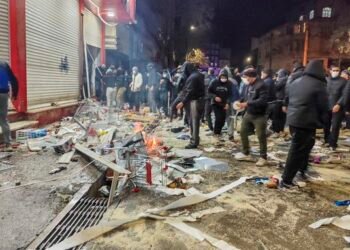
January 12, 2026: In the heart of Iran’s ancient cities, a powder keg of discontent has erupted into the country’s deadliest unrest in decades, transforming what began as peaceful demonstrations into scenes of fire, gunfire, and mounting international tension. As the Islamic Republic enters its 16th consecutive day of nationwide protests, graphic videos circulating on social media have ignited a fierce global debate over the boundary between self-defence and state brutality.
One widely shared clip shows a police officer engulfed in flames, allegedly set ablaze by rioters. Another captures terrified protesters in the holy city of Mashhad pleading for intervention from the United States amid crackling gunfire. With at least 538 confirmed deaths and over 10,000 detentions, the crisis has evolved from economic outrage into a direct challenge to the regime’s authority, drawing accusations of foreign orchestration and threats of war from global powers.
The unrest began on December 27, 2025, triggered by spiralling inflation, chronic unemployment, and acute water shortages—problems compounded by years of international sanctions and domestic mismanagement. What started as scattered rallies in provincial towns quickly snowballed into a nationwide movement. Protesters began chanting slogans against Supreme Leader Ayatollah Ali Khamenei and demanding an end to theocratic rule.
Women defying mandatory hijab laws and young men trapped in economic stagnation flooded the streets of Tehran, Isfahan, Shiraz, and Mashhad. Many waved Iranian flags stripped of the Islamic emblem, a potent symbol of their demand for secular governance.
Two videos have emerged as pivotal flashpoints, each reinforcing starkly opposing narratives.
The first was shared by Iran’s Foreign Minister Abbas Araghchi on his official X account. It shows a Basij militia officer—part of the paramilitary force loyal to the Revolutionary Guards—screaming in agony as flames engulf his uniform. “This is the true face of the so-called ‘peaceful protesters’—terrorists backed by Zionist and American intelligence,” Araghchi wrote.
State media has repeatedly aired the footage to portray demonstrators as violent insurgents bent on dismantling the Islamic Republic. Officials say the officer, identified as 32-year-old Reza Pourmandi, was ambushed during a patrol in Tehran’s working-class Narmak district. Though he survived, he remains in critical condition, intensifying calls within Iran for harsher crackdowns.
Shocking videos from a forensics centre near Tehran bear witness to the scale of the regime crackdown and the increasing violence on Iran’s streets: ‘More than 500 now dead’ following protests. Our report from Sunday https://t.co/UsyjhnCDGU via @YouTube
— Diana Magnay (@DiMagnaySky) January 11, 2026
In sharp contrast, a second video smuggled out of Mashhad—despite sweeping internet blackouts—shows around 20 protesters, including women and children, huddled in a dim alley as automatic gunfire echoes nearby. “Trump, help us! America, save us from this massacre!” they chant in unison.
Verified by digital forensics experts at Amnesty International, the footage has gone viral outside Iran, drawing widespread condemnation from human rights groups. “This is not a revolt; it’s a slaughter,” said one protester in an audio message later leaked to exiled journalists.
🅱️REAKING: Regime forces captured on video shooting civilians in Tehran. Iran protests death toll rises to 538 with over 10,600 arrested as IRGC opens fire indiscriminately.
Follow @badboibakademia https://t.co/uXRpAE3sfT
— 🅱️🅱️🅱️ (@badboibakademia) January 11, 2026
Human rights organisations estimate the death toll at 538, with many victims killed by live ammunition fired by security forces. Hospitals in major cities are overwhelmed, with reports of bodies piling up outside morgues. Power outages lasting up to 12 hours have plunged parts of Tehran into darkness, enabling mass arrests under the cover of night.
More than 10,000 people—including activists, journalists, and bystanders—have been detained. President Ebrahim Raisi has dismissed the protesters as “terrorists” and “foreign agents,” accusing Israel and the United States of engineering the unrest. “These riots are not organic,” Raisi said in a televised address. “They are scripted by Mossad and CIA operatives.”
Opposition figures strongly reject the claim, accusing the regime of conducting a systematic massacre to suppress dissent. “Security forces are using live ammunition, tear gas, and helicopters to hunt people down,” said Maryam Rajavi, leader of the exiled People’s Mujahedin of Iran. Activists allege that plainclothes agents infiltrated crowds to provoke violence, creating a pretext for lethal force. Some have questioned whether the burning of the police officer was staged or a desperate act of retaliation.
READ: Massive Setback for ISRO as PSLV Mission Falters After Launch
The crisis has drawn sharp international reactions. In Washington, President Donald Trump, following his 2024 re-election, issued a stern warning. “If Iran keeps killing its own people, we will respond with devastating force,” he said at the White House. The U.S. has since expanded sanctions targeting Revolutionary Guard commanders, while speculation grows over covert support for opposition groups.
Behind the scenes, Iranian officials appear divided. While publicly defiant, anonymous diplomatic sources suggest Tehran may be willing to reopen talks on nuclear and regional issues in a bid to ease economic pressure.
The unrest echoes the 2019 fuel-price protests, which killed more than 1,500 people, and the 2022 uprising following the death of Mahsa Amini. Yet analysts say the current revolt feels more existential. Iran’s economy is reeling, the rial has hit historic lows, inflation hovers near 50%, and water scarcity driven by climate change has pushed rural regions to the brink.
As rival narratives collide—one of popular resistance, the other of foreign-backed terrorism—the risk of escalation grows. Israel has raised its alert level, while European leaders, including French President Emmanuel Macron, have called for an emergency UN Security Council session.
In Iran’s streets, the cries for change grow louder. So does the sound of gunfire. Whether this revolt ends in reform, revolution, or regional war remains uncertain. What is clear is that the world is no longer merely watching—it is being pulled into the crisis.