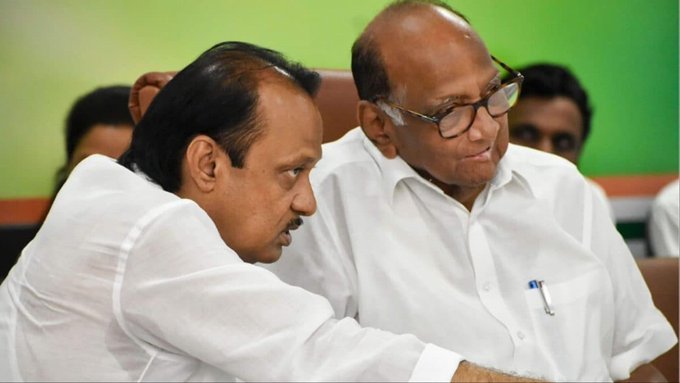
The reunion of Pawars follows calls for unity after the BJP-led Mahayuti’s Assembly election sweep, underlining the importance of local arithmetic over political differences.
BY PC Bureau
In Maharashtra’s endlessly fluid political theatre, symbolism often speaks louder than slogans. On Sunday, Deputy Chief Minister Ajit Pawar announced that the ‘clock’ and the ‘tutari’—the rival election symbols of the split Nationalist Congress Party—would reunite for the Pimpri-Chinchwad Municipal Corporation (PCMC) elections. More than a family reconciliation, the alliance between Ajit Pawar’s NCP and Sharad Pawar’s NCP(SP) reflects cold electoral pragmatism shaped by local arithmetic, regional dominance, and shifting power equations in the state.
The announcement comes over two years after the dramatic 2023 split, when Ajit Pawar walked out with a majority of NCP MLAs to join the BJP-led Mahayuti government, earning recognition from the Election Commission as the “original” NCP and retaining the party’s iconic clock symbol. Sharad Pawar, reduced to a faction, adopted the tutari and positioned himself firmly within the Opposition bloc at both state and national levels. The split fractured not just the party, but also its traditional strongholds—none more crucial than Pune and Pimpri-Chinchwad.
Why Pimpri-Chinchwad Matters
The Pimpri-Chinchwad Municipal Corporation is not just another civic body. One of the richest municipal corporations in the country after Mumbai’s BMC, it controls vast financial resources, infrastructure projects, and local patronage networks. Sharad Pawar’s undivided NCP has held the PCMC since 2017, making it a cornerstone of Pawar influence in western Maharashtra.
For both factions, a divided contest risked handing advantage to rivals, particularly the BJP and the Eknath Shinde-led Shiv Sena, which have been aggressively expanding their urban footprint. The reunion signals an acknowledgement that a fractured Pawar vote could be politically fatal at the local level—even if ideological differences persist at the state and national levels.
READ: Mizoram CM Condemns Vandalism Targeting Christmas Fests Across India
Development Narrative vs Power Arithmetic
Addressing party workers, Ajit Pawar framed the alliance in developmental terms, urging restraint and discipline during campaigning. His pitch—that the NCP represents governance and fiscal responsibility, unlike those who allegedly pushed the civic body into debt—was clearly aimed at urban voters wary of political instability.
Yet, beneath the rhetoric lies a sharper calculation. Calls for reconciliation grew louder after the BJP-led Mahayuti’s landslide victory in last year’s Maharashtra Assembly elections, which exposed the Opposition’s organisational weaknesses. For Sharad Pawar, retaining influence in municipal corporations is vital to staying politically relevant. For Ajit Pawar, consolidating the Pawar base helps insulate him from criticism that his 2023 defection weakened the party’s grassroots strength.
VIDEO | Mumbai: On Sharad Pawar-Ajit Pawar joining hands for Pimpri-Chinchwad municipal corporation elections, Shiv Sena leader Shaina NC says, “Anyone can come together, brothers or family, but politics of just surnames will not work here, only politics of performance will… pic.twitter.com/bCRhOgYLAk
— Press Trust of India (@PTI_News) December 28, 2025
Contradictions and Mixed Signals
The timing of the alliance also underlines the contradictions shaping Maharashtra politics. Just days earlier, sources suggested talks between the two NCP factions over the Pune civic polls were faltering, with Sharad Pawar reopening seat-sharing discussions with Uddhav Thackeray’s Shiv Sena (UBT) and the Congress. That Pimpri-Chinchwad has been resolved while Pune remains uncertain suggests the reunion is tactical, not transformational—limited to constituencies where mutual dependence outweighs political bitterness.
Reactions Reveal Fault Lines
Political reactions to the reunion further highlight its contested nature. BJP leader Navneet Rana claimed Ajit Pawar had joined the NDA on Sharad Pawar’s instructions, expressing hope that Sharad Pawar himself would soon follow—a remark as provocative as it was speculative. Within Ajit Pawar’s camp, leaders like Zeeshan Siddiqui welcomed the alliance as a step that would strengthen the party’s electoral prospects.
The Shiv Sena factions, however, were quick to dismiss the reunion’s impact. Leaders from the Eknath Shinde Sena and Shiv Sena (UBT) alike argued that “surname politics” would not sway voters, asserting that performance, not pedigree, decides elections. Their criticism underscores a broader challenge for the Pawars: whether legacy still translates into votes in an increasingly fragmented and aspirational urban electorate.
A Limited Reunion with Broader Implications
With elections to 29 municipal corporations scheduled for January 15 and nominations closing on December 30, the Pawar reunion in Pimpri-Chinchwad is best seen as a ceasefire, not a full rapprochement. It reflects the enduring influence of the Pawar brand in western Maharashtra, but also its vulnerability when divided.
Ultimately, the alliance underscores a recurring truth of Indian politics: ideology may divide, ambition may provoke splits, but elections—especially local ones—often force rivals back to the same table. Whether this reunion delivers electoral dividends or merely postpones deeper fault lines will be revealed not in speeches, but at the ballot box.