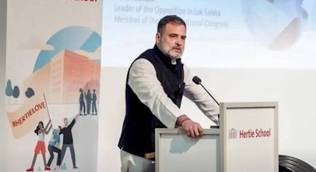
Speaking at an event in Berlin, Rahul Gandhi raised concerns over alleged irregularities in recent state elections, claiming enforcement agencies and institutions have been “weaponised.”
BY PC Bureau
New Delhi, December 23, 2025: In a candid and wide-ranging address at Berlin’s Hertie School on December 22, 2025, Rahul Gandhi, Leader of the Opposition in the Lok Sabha, launched a sharp critique of the state of Indian democracy, alleging a “full-scale assault” on the country’s institutional framework by the ruling Bharatiya Janata Party (BJP). Speaking on the theme “Politics is the Art of Listening,” Gandhi stressed the importance of democratic engagement while raising concerns over electoral integrity, institutional capture and global economic shifts.
Delivered during his visit to Germany, the remarks triggered a political storm back home, with the BJP accusing him of defaming India on foreign soil.
Addressing students, academics and members of the Indian diaspora, Gandhi drew on his political journey and extensive travels across India to argue that leadership must be rooted in empathy and dialogue. He contrasted this approach with what he described as growing authoritarian tendencies in contemporary politics. As part of his visit, Gandhi also met senior German leaders, including former Chancellor Olaf Scholz and Minister Carsten Schneider, with discussions reportedly focusing on climate change, education, and strengthening India–Germany cooperation in trade, technology and sustainability.
Invoking Berlin’s history as a symbol of resilience and unity, Gandhi opened his speech by highlighting global challenges such as technological disruption, climate change, geopolitical shifts and rising inequality, drawing parallels with India’s own transition. Central to his address was his assertion that “politics is the art of listening,” which he illustrated with anecdotes from across India, underscoring the role of empathy in sustaining democracies.
Turning to domestic issues, Gandhi reiterated the Congress’s concerns over electoral fairness. He cited alleged anomalies in recent state elections and accused the Election Commission of failing to respond to opposition queries. “We have raised serious questions about the fairness of elections,” he said, claiming discrepancies in voter lists and outcomes in Haryana and Maharashtra.
Gandhi also accused the BJP of a “wholesale capture” of institutions, alleging that agencies such as the CBI and ED had been weaponised against political opponents. He pointed to what he described as a stark imbalance in political funding, citing electoral bonds as a key factor benefiting the ruling party.
Watch: Shri @RahulGandhi speaks at the Hertie School – ‘Politics is the art of listening’ | Berlin, Germany. https://t.co/304NdurE0R
— Congress (@INCIndia) December 22, 2025
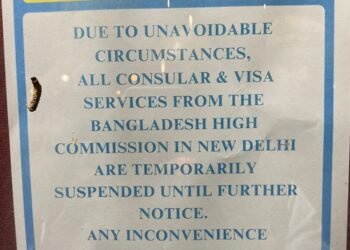
READ:Bangladesh Suspends Visa Services in Delhi After Protest at High Commission
Outlining the opposition’s strategy, Gandhi said the INDIA alliance was united in its opposition to the RSS ideology, even as tactical differences remained. “This is no longer just an electoral battle. It is a fight for an alternative vision of India,” he said.
On global developments, Gandhi spoke of a shifting world order and a decline in U.S. hegemony, warning that over-reliance on service-driven economies and the loss of manufacturing to China had fuelled job crises and political polarisation. He argued that democracies would struggle to survive without strong domestic production and employment generation.
Rooting his message in Indian cultural values, Gandhi invoked truth as a foundational principle across religions, contrasting it with what he described as a politics driven solely by power. He concluded by praising the Indian diaspora in Germany as “ambassadors of India” and called for deeper India–Germany collaboration based on shared democratic values.
The speech was followed by a Q&A session in which Gandhi elaborated on climate action, education and India’s global role.
BJP hits back
Gandhi’s remarks drew swift criticism from the BJP. Party president and Union Minister JP Nadda accused him of speaking against India abroad while Parliament was in session, calling his comments irresponsible. BJP spokesperson Shehzad Poonawalla termed the visit a “Defame India” tour, alleging that Gandhi had misrepresented India’s manufacturing and institutional strength while praising China.
Other BJP leaders dismissed his claims on electoral irregularities as unfounded, noting that no formal complaints had been upheld by the Election Commission and urging opposition leaders to raise concerns through domestic forums.
The speech comes amid heightened political tensions following recent state elections, with opposition parties alleging irregularities. While critics view Gandhi’s overseas remarks as an attempt to internationalise domestic issues, supporters within the Congress have described the address as a robust defence of democratic values.
As the debate intensifies, Gandhi’s speech has once again highlighted deep political divisions, raising questions about India’s democratic discourse and its global perception.