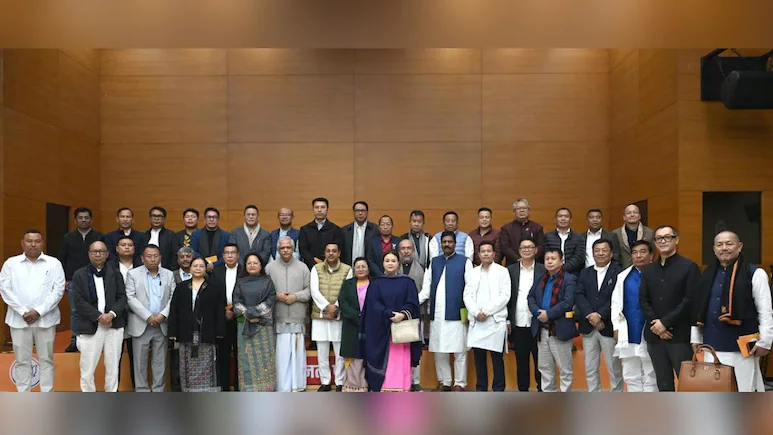
Four Kuki-Zo MLAs attending a BJP-led meeting in Delhi has triggered outrage and despair within the community, exposing deep fractures in leadership and the steady erosion of the Union Territory demand amid prolonged institutional silence.
Navin Upadhyay
December 15, 2025 — A deep sense of despondency has gripped the Kuki-Zo community in Manipur following a dramatic political turn that many see as a betrayal of hard-won collective aspirations. On Sunday, four of the seven Kuki-Zo Members of the Legislative Assembly (MLAs) travelled to Delhi to attend a high-stakes meeting convened by the BJP’s central leadership. There, they sat alongside Meitei MLAs—until recently described as political adversaries—to deliberate on “peace” and the formation of a so-called “popular government” in Manipur.
The subtext was unmistakable. The meeting effectively sidelined the Kuki-Zo community’s long-standing demand for a separate Union Territory under Article 239A and signalled a push to reintegrate Manipur’s warring ethnic blocs under a single political dispensation.
Predictably, the Meitei political ecosystem responded with visible triumphalism. Social media platforms, especially X, were flooded with celebratory posts declaring the “death of Kuki-Zo dreams,” framing the MLAs’ participation as a final capitulation. The symbolism was stark. Barely two years ago, these same legislators had signed a searing memorandum to the Centre documenting mass killings, arson, sexual violence, and displacement suffered by Kuki-Zo tribals, and had unequivocally endorsed the demand for a Union Territory as the only viable path to safety and dignity.
What, then, changed so decisively?
The answer lies less in altered ground realities and more in the slow collapse of internal political resolve—marked most glaringly by the silence and abdication of responsibility by key Kuki-Zo civil society institutions—and leaders.
A Mandate Squandered: The Rise and Decline of the Kuki-Zo Council
At the centre of this crisis stands the Kuki-Zo Council (KZC), the apex body created precisely to prevent such drift. Constituted through a historic consultative meeting at Tuibong on March 7, 2025, the KZC was unanimously mandated to act as the singular political and administrative voice of the Kuki-Zo people. Representatives of elected bodies, traditional institutions, and major CSOs—including the Indigenous Tribal Leaders’ Forum (ITLF), Committee on Tribal Unity (COTU), and Kuki Inpi Manipur (KIM)—endorsed the Council as the sole authority for political communication, crisis response, and strategic direction. Smaller organisations were confined to local issues; the larger political roadmap, particularly the Union Territory demand, was entrusted to the KZC.
Nine months on, that mandate lies in ruins.
The KZC has become synonymous with inconsistency, inertia, and prolonged silence. Its absence at critical moments has created a vacuum that opportunistic politics has rushed to fill. The clearest illustration came during the Guwahati Conclave on November 15–16, 2025—ironically organised by the KZC itself. While Kuki-Zo leaders were still deliberating, The Sangai Express published a report claiming that Kuki-Zo MLAs had resolved to join an elected government in Manipur.
The Council’s response? None.
For more than 24 hours, as outrage exploded across social media and misinformation spread unchecked, the KZC remained silent. It fell to two MLAs and the ceasefire groups—the Kuki National Organisation (KNO) and United People’s Front (UPF)—to issue denials. The apex body’s failure to clarify or rebut the report severely damaged its credibility, raising uncomfortable questions about whether it was complicit, paralysed, or simply irrelevant.
This pattern has repeated itself with disturbing regularity.
🚨 MANIPUR POLITICAL DEVELOPMENTS
BJP MLAs from Manipur belonging to both the Meitei and Kuki communities met under one roof in New Delhi on Sunday for the first time since May 2023, holding talks with the party leadership. The meeting has sparked speculation about possible… pic.twitter.com/CU7b3rqxLF
— Eshani Verma (@eshaniverma809) December 14, 2025
On November 4, four teenage Kuki-Zo boys were killed during a counter-insurgency operation in Khanpi village, Henglep subdivision. Eyewitnesses alleged that the youths were shot at close range, some reportedly while asleep. Grassroots organisations—including KIM, Kuki Organisation for Human Rights (KOHUR), Kuki Students’ Organisation (KSO), and Kuki Women’s Union (KWU)—condemned the killings as a “state-sponsored atrocity” and demanded accountability.
The KZC said nothing.
It neither demanded an independent inquiry nor sought post-mortem reports, nor even issued a statement of condolence. For an apex body claiming to represent a traumatised people, the silence was deafening—and deeply corrosive.
READ: Analysis: Why PK and Congress Both Need Each Other
READ: Crores for a Messi Handshake, Pennies for Indian Athletes
Fear, Pressure, and the Politics of Quietude
The Council’s inertia is not merely administrative failure; it reflects a deeper malaise shaped by fear, pressure, and a misguided pursuit of “balance.” With negotiations ongoing between ceasefire groups and the Ministry of Home Affairs, KZC leaders appear wary of strong statements that might jeopardise talks or invite retaliation from security agencies heavily deployed in hill districts.
This dynamic was laid bare during President Droupadi Murmu’s visit to Manipur. The KZC issued a warm welcome despite her refusal to visit Kuki-Zo-dominated districts or accept their memorandum. Instead, she remained in Imphal and Senapati, engaging with Meitei and Naga constituencies. The Council also remained silent when symbolic martyrs’ coffins were forcibly removed from Churachandpur’s Wall of Remembrance ahead of Prime Minister Narendra Modi’s visit. Each instance reinforced perceptions of a leadership unwilling—or unable—to assert dignity.
The Council’s repeated announcement and abrupt withdrawal of mass protests, often reportedly at the MHA’s urging, has further eroded trust. What was meant to project discipline now reads as pliability.
From Unity to Drift
The Delhi meeting attended by four Kuki-Zo MLAs— Nemcha Kipgen, Lelzamang Haokip, L. M. Khoute, Ngursanglur Hmar– amid reports that two more may follow—did not happen in isolation. It was enabled by the KZC’s failure to issue timely warnings, enforce its Tuibong mandate, or mobilise public pressure. When rumours of the trip surfaced, no directive was issued. No red line was drawn. The result was predictable: MLAs acted knowing there would be no consequences.
What remains is a fractured leadership landscape. Ceasefire groups negotiate quietly. CSOs fragment into local silos. The apex body whispers when it should speak. In such a vacuum, political defection becomes inevitable.
As one analyst observed, in moments of existential crisis, silence is not neutrality—it is abandonment.
For the Kuki-Zo people, reclaiming agency now requires hard choices: either reinvigorate the Kuki-Zo Council with clarity, courage, and accountability, or dismantle it in favour of a structure that can genuinely articulate collective will. Without such course correction, the demand for a Union Territory—and the moral force behind it—risks dissolving into the very silence that now defines the moment.