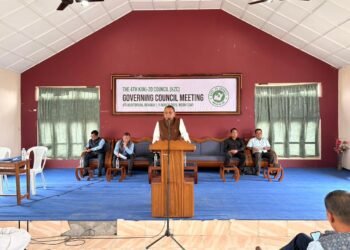
Bhagwat did not visit the Kuki-Zo or Naga-inhabited hill districts, nor did he meet mainstream tribal leaders who hold the key to any durable resolution of Manipur’s crisis.
Navin Upadhyay
November 22, 2025: Back in June 2024, when the Rashtriya Swayamsevak Sangh (RSS) chief Mohan Bhagwat publicly remarked that the crisis in Manipur “should be resolved as a priority,” a statement widely interpreted by opposition parties as an indirect nudge to Prime Minister Narendra Modi to give the strife-torn state the attention it urgently needed. So when Bhagwat himself arrived in Manipur for a three-day visit, many wondered whether the most powerful unelected figure in Indian politics might bring some measure of reassurance to a region devastated by unprecedented ethnic violence.
After all, if anyone outside the government carried the moral weight and political influence to push New Delhi toward justice, reconciliation, and meaningful outreach, it was Bhagwat.But as the visit unfolded—and ended, it became clear that Bhagwat had not come to heal — and perhaps had never intended to.
Bhagwat Reveals Efforts to Install Elected Govt in Manipur https://t.co/o15Jj7Phpw #ManipurPolitics #MohanBhagwat #RSS #PoliticalStability #PeaceBuilding #EthnicHarmony
— Navin Upadhyay (@Navinupadhya) November 20, 2025
A Visit Confined to Imphal
In a state literally divided between valley and hills, geography is a political message.
Bhagwat’s choice to remain entirely in Imphal, the Meitei-majority valley, was read by many as a statement in itself.
He never set foot in the tribal hill districts — the very regions that have faced the heaviest displacement, trauma, and loss.
No stop in Kangpokpi.
No outreach in Churachandpur.
No visit to relief camps where families still wait for justice and a return to dignity.
In a conflict defined by distrust and dispossession, absence itself becomes a verdict.
No Engagement with Core Tribal Leadership
If peace in Manipur requires anything, it is dialogue with those who actually hold influence in the conflict-scarred hills.
Yet Bhagwat did not meet mainstream tribal leaders — not the apex bodies, not the church leadership, not the representative civil society groups that have shaped the hill communities’ response over two years of violence.
These groups are the key to any long-term resolution.
They understand the pain of their communities, they articulate their grievances, and they hold moral legitimacy among their people.
Instead, Bhagwat met a handful of “Janjati” leaders — a fringe set of individuals with no real constituency, no grassroots mandate, and no serious role in resolving the turmoil.
For many in the hills, it felt like a performance of outreach, not the real thing.
No Attempt to Win Trust or Offer Hope
The hill communities waited to see whether the RSS chief would use his stature to offer reassurance — or at least signal that their suffering mattered.
But Bhagwat made no effort to win their trust, no gesture to the wounded, no acknowledgement of the deep, ongoing humanitarian crisis.
There was no promise that he would use his considerable influence over the government to:
- address demands for justice in cases of killings,
- ensure accountability for security excesses,
- push for rehabilitation, or
- start a dialogue process rooted in fairness.
For a man whose voice can reshape the national political climate, the silence was deafening.
A Wasted Opportunity
From the standpoint of offering a healing touch, Bhagwat’s Manipur visit was a squandered chance — one that could have helped bridge a dangerous ethnic divide, or at least soften the edges of rage and mistrust.
He could have walked through a relief camp, listened to displaced families, acknowledged the grief of communities who feel unseen by the state.
He could have spoken words that signalled empathy.
He could have nudged the government to break its silence on justice.
None of that happened.
READ: ‘Hindus Sustain the World’: Bhagwat’s Remark Ignore Manipur’s Complexity
RSS: Kuki-Zo Council Slams Bid to Breach Buffer Zone in Manipur
But Perhaps Healing Was Never the Agenda
To be fair, Bhagwat never claimed he came to Manipur to play the role of reconciler.
He did not promise healing, nor did he frame the visit as one aimed at mending fractures.
He met whom he wanted to meet, stayed where he felt comfortable staying, and left without shifting the emotional or political landscape of the state.
In that sense, the disappointment is less about what he did — and more about what people hoped he might do.
Because Manipur today is a state desperate for understanding, recognition, and justice.
Someone of Bhagwat’s stature could have offered even a sliver of that.
Instead, the visit ended as just another reminder of how Manipur’s wounds remain unacknowledged by those with the power to help heal them.